

The best mover for an Upper West Side apartment is the one that clears your building before the truck rolls. Between 59th and 110th Streets most moves run through pre-war co-ops and condos — the neighborhood’s historic district alone protects more than 2,000 buildings from the 1880s to the 1930s — where a move typically needs a Certificate of Insurance of at least $1 million, a reserved elevator window on a weekday, and a crew that can work a street where New York offers no way to reserve curb space for a truck. At market rates, most Upper West Side studio and one-bedroom moves land between $400 and $1,100.
What an Upper West Side Move Costs
On the Upper West Side the price of a move is written in the building, not the mileage. A one-bedroom in an elevator co-op on West End Avenue and the same furniture in a fourth-floor brownstone walk-up off Columbus are different days — and the estimate should say so before anyone lifts a box. The ranges below are 2026 Manhattan market estimates by home size. There is no minimum number of hours on any Big Apple Moving job, and a single guaranteed price for the full job can be agreed in writing instead.
| Move Size | Typical Inventory | Market Estimate | Estimated Time |
|---|---|---|---|
| Studio | Pre-war studio or alcove | $400–$800 | 2–4 hours |
| 1 Bedroom | One-bedroom co-op or condo | $500–$1,100 | 3–5 hours |
| 2 Bedroom | Two-bedroom or partial classic six | $900–$1,800 | 5–8 hours |
| 3 Bedroom | Full classic six or seven | $1,300–$2,800 | 7–12 hours |
Note: Manhattan 2026 market estimates, not a quote. Building access — elevator or walk-up, and the carry to where the truck can legally stand — moves the number more than the block count. Contact us for a written estimate for both addresses.
Built for Buildings With Rules

COI Same Business Day
Upper West Side managements want the certificate before they release the elevator. Issued, named and filed the same business day, free.

No Minimum Hours
A studio move inside one elevator building can be a short day — we bill the job, not a minimum.

5.0 Stars · 2,300+ Reviews
A perfect Google rating across more than 2,300 verified customer reviews.

Since 1979 in NYC
More than 220,000 moves — a healthy share of them up and down the same twenty avenues and cross streets.

NY DOT #T-9942
Active New York State Department of Transportation authority. Documentation available on request.

Booking 24/7
Board approvals and elevator windows set the schedule here — book around the clock, with support 7AM–9PM.
Moving Services on the Upper West Side


Packing Services
Pre-war apartments hold decades of shelves; full or partial packing the day before.
Piano Moving
The neighborhood that practically invented the apartment piano deserves movers who know its stairwells.



Avenues of Co-ops, Side Streets of Brownstones
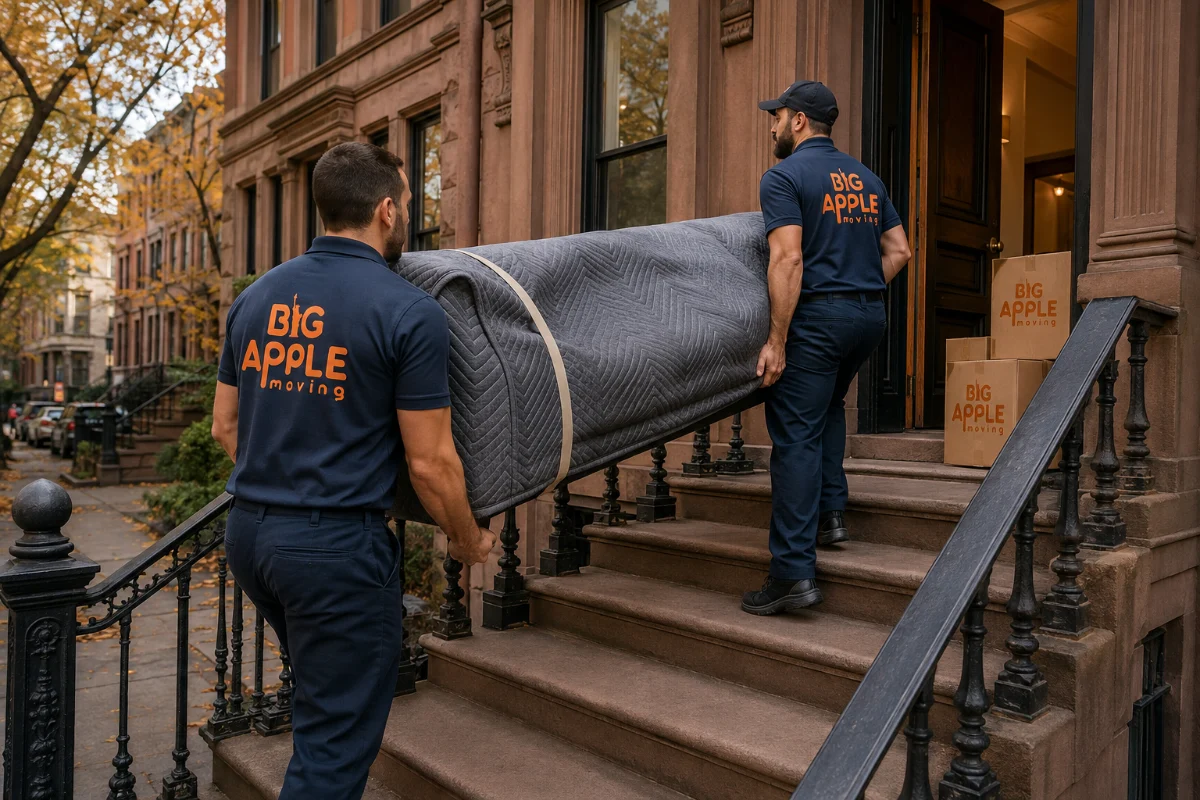
The Upper West Side moves in two registers. Along Central Park West, West End Avenue and Riverside Drive stand the great pre-war co-ops — the neighborhood’s historic district protects more than 2,000 buildings raised between the 1880s and the 1930s — with doormen, service entrances, freight elevators and boards that treat moving day as a scheduled event. On the side streets between them sit the brownstones: three and four storeys, stoops, and staircases that were generous in 1890 and are honest work today.
The difference is not cosmetic — it is the whole estimate. A classic six in an elevator building is a service-entrance job with a booked freight window; the same square footage split across a walk-up is a carry measured in flights. We crew for the building you actually live in, wrap for plaster hallways and original banisters, and put the answer in writing before the day.

The Co-op Move, in Order
Your management’s requirements collected up front — the Certificate of Insurance, typically at least $1 million and naming the building, filed the same business day.
Freight elevators here are reserved, often a week or more out and typically on weekday business hours. We book it with the agent, not around them.
New York offers no way to reserve curb space for a moving truck, so the plan works with posted rules and alternate-side schedules — solved before the crew rolls, not during.
Wrapped, carried, placed and rebuilt inside the window — with the elevator padded and the hallway as we found it.
Walk-Ups, Stoops and the Crosstown Question
Brownstone moves reward preparation: furniture measured against the stair turn, pieces that come apart taken apart, and a crew sized for flights rather than floor area. It is why a one-bedroom on a side street books more hours than the same one-bedroom on the avenue — the inventory is identical; the building is not.
And the crosstown question comes up weekly: the park sits between you and the East Side, and truck routing around it is constrained — so a Manhattan crosstown move is planned like the short-distance job it is, with the route and both buildings’ windows settled in the estimate. Wherever the truck can and cannot go, that is our problem to have solved in advance.
Upper West Side Moving — Frequently Asked Questions
At 2026 Manhattan market rates, an Upper West Side studio typically runs $400–$800, a one-bedroom $500–$1,100, a two-bedroom $900–$1,800, and a full classic six or larger $1,300–$2,800. The building sets the hours — elevator co-op or brownstone walk-up — more than the distance does. There is no minimum number of hours. Send both addresses for a written estimate.
Three things, in order: a Certificate of Insurance issued fast enough to satisfy your management before the elevator is released; real experience with pre-war buildings — service entrances, padded elevators, plaster hallways; and a written estimate that prices your building’s access, not just your inventory. References from doorman buildings in the neighborhood settle most doubts.
Almost certainly, if the building is managed — most New York buildings require one before approving a move, typically for at least $1 million and naming the building and its managing agent. We issue and file COIs the same business day at no charge; send your management’s contact when you book.
Most managed buildings here schedule moves on weekday business hours, with the freight elevator reserved in advance — often a week or more out, longer at month-end. Weekend moves are the exception and building-specific. The earlier the window is booked, the more of the calendar you keep.
No one can — New York offers no residential permit for reserving curb space, on the Upper West Side or anywhere else. What a professional crew does instead is plan around posted rules and alternate-side schedules, position the truck legally, and size the carry accordingly. It is a solved problem when it is solved in advance.
Usually, yes — not because of the address but because of the flights. The same one-bedroom books roughly an extra hour or two in a fourth-floor walk-up versus a freight-elevator co-op: more carrying, more disassembly, more protection on the stairs. The written estimate prices the building you actually live in.
Yes — floor-to-floor moves inside one co-op and same-block moves are regular work here, and with no minimum hours the small version of the job is billed for what it takes. The building’s rules still apply in full: COI, elevator window, padding.
Yes — crosstown is a short-distance move with one complication: truck routing around the park is constrained, so the route is planned with the estimate, not improvised on the day. Both buildings’ elevator windows matter more to the schedule than the crossing itself.
As soon as your dates firm up — the freight elevator is usually the bottleneck, often reserved a week or more ahead and competitive at month-end. Booking is open around the clock; a written estimate locks the plan, and storage can cover a gap between a closing and a board approval.


