

Quick answer: Moving a small number of antique pieces in New York City typically costs $300 to $900, depending on crew size and how much crating is needed. Custom wooden crating runs $150 to $400 per item. An antique-heavy household move runs $1,200 to $2,600. Every piece is condition-reported and photographed before it is wrapped.
An antique is not simply an old piece of furniture. It is usually irreplaceable, often structurally fragile in ways that are not visible, and frequently worth more than the rest of the room combined. The risk in moving one is rarely that it gets dropped. It is that a joint that has been dry for eighty years is asked to carry weight it no longer can.
Big Apple Moving has handled antiques out of New York apartments and estates since 1979. That means period furniture, longcase and mantel clocks, mirrors and gilt frames, marble and stone tops, and the inherited pieces families move once and never want to move again.
What Antique Moving Costs in NYC
Antique work is billed at our standard hourly rates, plus materials. What changes the number is how much of the job is crating and disassembly rather than carrying.
| Job | Crew | Hours | Typical cost |
|---|---|---|---|
| One or two pieces | 2 movers | 2 – 3 | $300 – $500 |
| A room’s worth, several pieces | 2-3 movers | 3 – 5 | $500 – $900 |
| Antique-heavy full household | 3-4 movers | 6 – 10 | $1,200 – $2,600 |
| Single item, long carry or stairs | 3 movers | 2 – 3 | $400 – $650 |
Add-ons. Custom wooden crate $150 to $400 per item depending on size. Soft crate or double-boxing $60 to $120 per item. Marble or stone top moved separately $120 to $250 per top. Clock movement service on site is quoted per piece.
These are market-rate estimates, not guaranteed quotes. The price is set after a survey. Full hourly rates by crew size are on our hourly movers page.
What Makes an Antique Different to Move

The difference is not fragility in the obvious sense. It is that antique construction, finishes and weight distribution all behave unlike modern furniture, and each one fails in its own way if it is handled as though it were new.
Four things decide whether a piece arrives intact:
How We Handle Antiques
Antiques We Move Most Often
Period furniture
Armoires, secretaries, highboys, dining tables and chair sets. The bread and butter of antique work, and the pieces most likely to need disassembly.
Longcase and mantel clocks
The pendulum, weights and movement travel separately from the case. There is a section on grandfather clocks below.
Mirrors, gilt frames and glass
Gilt is powder-fragile and cannot be handled directly. These travel crated or in mirror cartons with corner protection.
Marble, stone and glass tops
Always removed and moved flat on edge, never laid down. Stone breaks under its own weight.
Chests, trunks and cabinetry
Usually heavier than they look, and often with original hardware that catches on door frames.
Inherited and estate pieces
Single items out of a family home, often to a different state. See single item movers for one-piece jobs.
Paintings, sculpture and gallery work are handled by our fine art movers, pianos by our piano movers, and pool tables by our specialist team.
Moving a Grandfather Clock
A longcase clock is the single most commonly damaged antique in a move, and almost always for the same reason: it was moved assembled.
The pendulum, the weights and the chime rods must come out before the case is tilted. If the weights are left hanging they swing into the movement, and the repair costs more than the move did. The case itself is tall, narrow and top heavy, and needs two people and a proper stair plan rather than a dolly.

We remove and label the movement components, pack them separately, move the case upright, and rehang everything at the other end. If the clock needs regulating afterwards we will tell you honestly that it does — most do.
Insurance and Valuation for Antiques
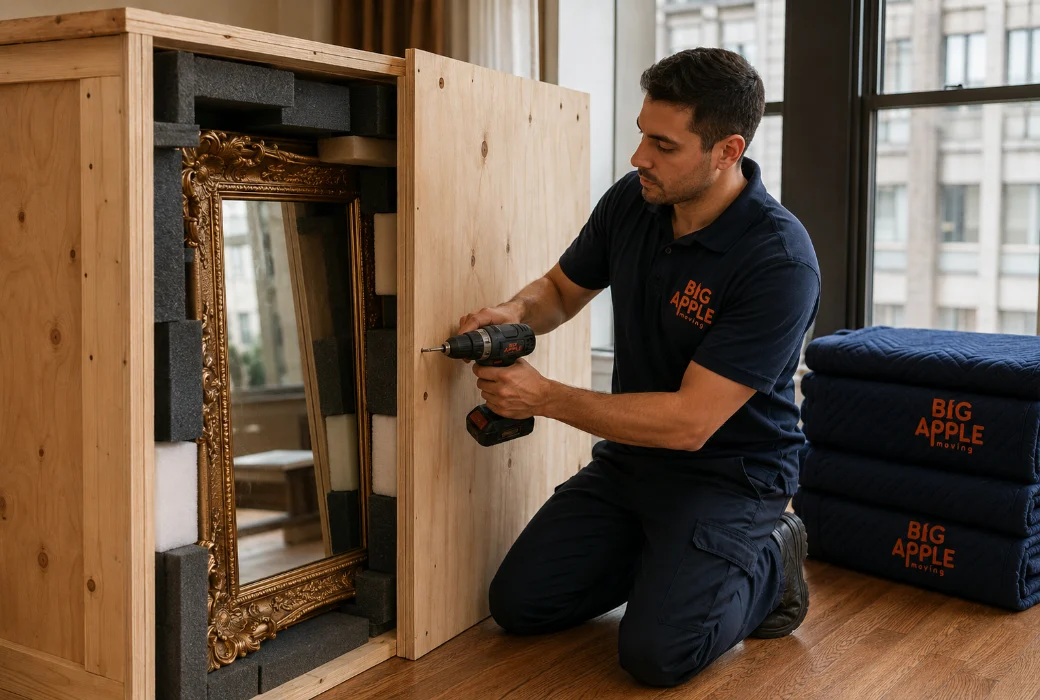
Standard released-value protection is calculated by weight, and for antiques that is close to meaningless — it would value a two-hundred-year-old bureau at a few dollars a pound.
For antique work you want full value protection, declared at the piece’s actual value. If you have a recent appraisal, tell us the figure when you book. If you do not, we would rather you get one for the significant pieces before the move than discover the gap afterwards.
We are USDOT licensed and carry the insurance New York buildings require. If your building or your dealer needs a certificate of insurance before we can load, tell us the management company when you book — see COI movers.
Antique Moving — Frequently Asked Questions
Costs, protection, insurance and clocks.


