

Big Apple Moving has been moving New Yorkers since 1979, and gym equipment is one of the few things people consistently underestimate. A home treadmill weighs more than a washing machine, does not fit through a standard doorway upright, and has a motor housing that cracks if it is set down wrong. This page is the detail: what it costs, what each machine weighs, what has to come apart, and what we will not touch.
What Does It Cost to Move Gym Equipment in NYC?
You will find figures online putting a treadmill move at $150 to $400 and gym-equipment movers at $70 to $80 an hour. Those are national averages and they do not survive contact with New York.
We do not hold you to a minimum number of hours, so a treadmill that takes twenty minutes is billed as twenty minutes rather than as a block of time you did not use. There is no minimum, so a short job is billed as a short job. A mover quoting you $150 for a treadmill in Manhattan is quoting a job they are not going to show up to.
| What you are moving | Crew | Typical hours |
|---|---|---|
| One treadmill, Peloton or bike, elevator at both ends | 2 movers + truck | 2 – 3 |
| One heavy piece, walk-up or long carry | 2 movers + truck | 3 – 4 |
| Home gym: cardio machine, rack, bench, weights | 3 movers + truck | 4 – 6 |
| Home gym moved with the rest of the household | 4 movers + truck | 7 – 9 |
| Boutique studio or small gym floor, 15 – 25 pieces | 5 movers + truck | 8 – 12 |
| Repositioning equipment inside one building | 2 movers, no truck | 2 – 3 |
Jobs are billed hourly from $150 with the truck included and no minimum number of hours, so the hours above are the part that matters. We confirm the crew and the rate before you book.
These are market-rate estimates for a local move within New York City, not guaranteed quotes.
Three things about that table are worth saying out loud.
The first row is a minimum, not a price. If you have one Peloton going four blocks, you are paying for three hours because that is the smallest block anyone sells. If you have a second item to move, add it – it will not cost more.
The last row is the cheapest thing on this page and almost nobody asks for it. If the equipment is not leaving the building – a new floor, a room swap, a renovation – you do not need a truck. Two movers on their own run $90 to $120 an hour. Our full breakdown of that is on the hourly movers page.
Stairs are the variable that breaks estimates. A 300 lb treadmill down three flights is not one and a half times harder than one flight, it is closer to three times, and it needs a fourth pair of hands. If your building has no elevator, tell us at the quote stage. If you would rather the number not move at all, our flat fee movers page explains how we fix it in advance.
What Your Equipment Actually Weighs
Most of the difficulty in a gym move is decided before anyone lifts anything, by the weight and the shape of what you own. These are published figures, not estimates.
| Equipment | Typical weight | Why it matters on the day |
|---|---|---|
| Rowing machine | Around 65 lb | The one piece two people can genuinely carry. Most fold or separate. |
| Peloton Bike | 135 lb bare, about 148 lb assembled | The screen is the fragile part, not the frame. It comes off in minutes. |
| Peloton Bike+ | About 152 lb | The rotating screen mount has to be locked before it moves. |
| Elliptical | 100 – 250 lb | Long, off-balance, and the flywheel sits at one end. Awkward rather than heavy. |
| Home treadmill | 150 – 250 lb | Will not clear a standard doorway upright. Folding decks pivot when tilted. |
| High-end home treadmill | Around 300 lb | Four movers, or a stair-climbing dolly, once stairs are involved. |
| Commercial treadmill | 400 lb and up | Assume disassembly. Assume a freight elevator. Plan the route first. |
| Power rack or Smith machine | Bolted, plate-loaded | Comes apart into six to twelve pieces. Budget the time, not the muscle. |
The number that surprises people is the commercial treadmill. At 400 lb and up it weighs more than a full-size refrigerator with the door on, and unlike a refrigerator it has a running deck that flexes if it is carried from the wrong two points.
What Comes Apart, and What Does Not
Disassembly and reassembly are inside our hourly rate – there is no separate handyman fee – but they are on the clock, so it is worth knowing in advance which category each piece falls into.
If you would rather we handled reassembly as a separate visit after the move, our furniture assembly and disassembly service covers that.
Peloton, Tonal and Connected Equipment
Connected fitness equipment is the part of this job that has changed most in the last five years, and it is where the honest answer is worth more than the confident one.
Two of the most common machines in a New York apartment now come with rules the manufacturer wrote, not the mover.
Peloton. Peloton’s limited warranty excludes damage resulting from relocation, and from improper or negligent assembly or disassembly. Peloton’s own relocation guide for the Tread states that it is written for trained professional installers using specialised tools. The touchscreen is not built to take impact or vibration.
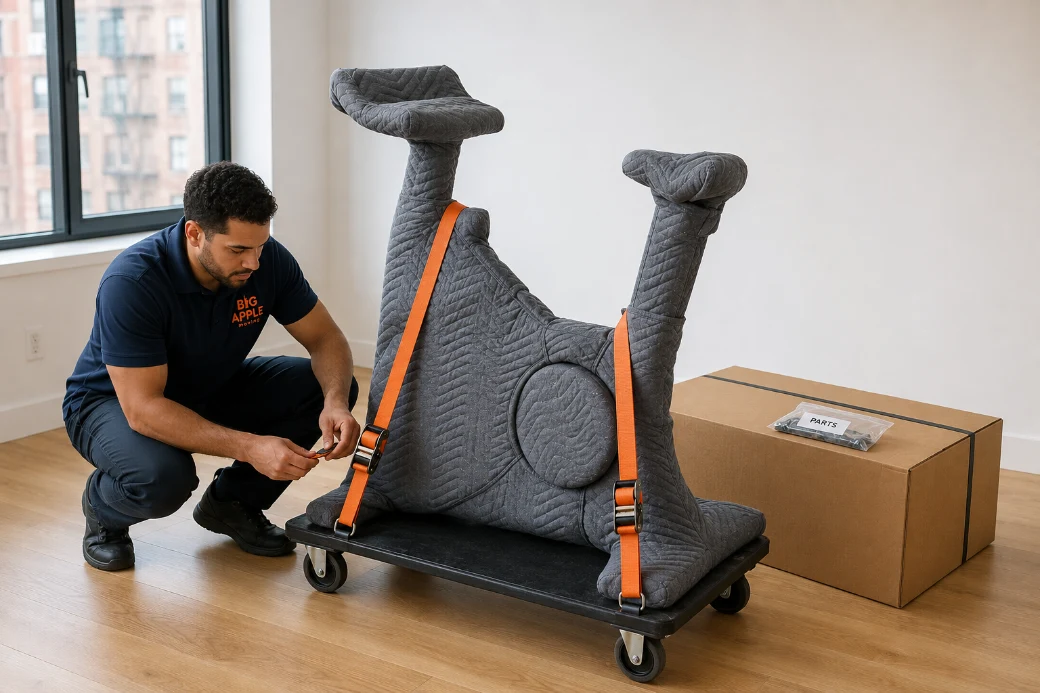
What that means in practice: if the frame is scratched or the screen cracks during a move, that is not a warranty claim, whoever moved it. So we remove the screen and the pedals, box them separately, blanket and strap the frame, and carry it as two items rather than one. Our cargo coverage applies to it the same as anything else in a Big Apple Moving truck. A Bike or Bike+ moves as a single item on the first row of the cost table.
Tonal and wall-mounted systems. A Tonal is bolted into wall studs. Tonal’s installation spec calls for seven feet of clear wall, a seven by seven foot floor area, seven feet ten inches of ceiling, and a door jamb no wider than eight inches. Tonal sells its own Detach and Reinstall service for exactly this reason.
We do not unbolt a Tonal, and you should be wary of any mover who says they will. Book Tonal’s detach service for the days before your move and we will carry and transport the unit once it is off the wall. The same applies to any wall-anchored or ceiling-anchored rig.
Mirror, Tempo, Hydrow and similar. Free-standing units move as normal items. Wall-mounted units follow the Tonal rule: the manufacturer takes it off the wall, we move it.
The New York Problems Nobody Mentions

The Doorway, Not the Weight
A 30-inch doorway is the constraint on most home gym moves, not the staircase. A treadmill that clears it upright is rare. We measure the narrowest point on the route – usually a corridor turn or the elevator car depth – before we decide whether a piece travels whole.

Freight Elevator Windows
Managed buildings release the freight elevator for a fixed window, and a gym move eats windows faster than a furniture move because each piece takes a full car. Book the longest window your building offers. We issue the certificate of insurance free.

Floor Loading in Older Buildings
A rack plus 600 lb of plates concentrated on four feet is a point load, not a distributed one. Some pre-war buildings and some co-op boards have a view on this. If your building asks, ask us – we have laid out gym floors in enough of them to know what they want to hear.

Walk-Ups Change the Crew, Not Just the Hours
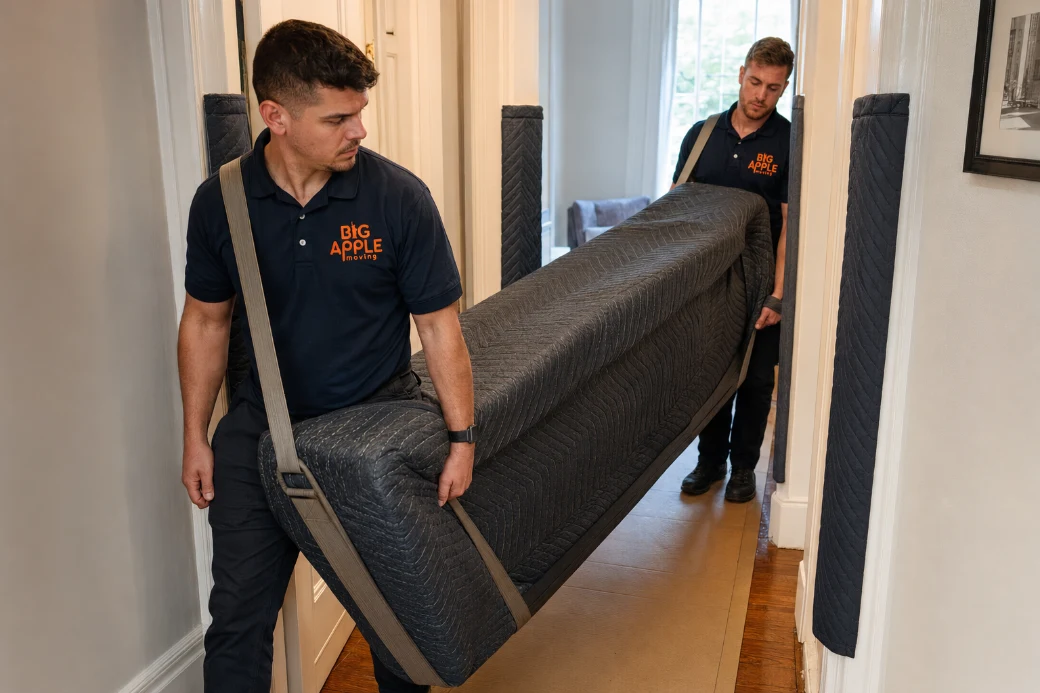
Above the second floor with anything over 250 lb we send four movers rather than three. It costs more per hour and less in total, and it is the difference between a controlled carry and a dropped machine.

The Plates Go in Their Own Load
Dumbbells and weight plates are dense, small and heavy, and they will destroy a box. They travel in small crates at the bottom of the load, never stacked on anything. Twenty 45 lb plates is 900 lb in about four square feet.

Nothing Gets Dragged
Not across a finished floor, not across a truck deck, not across the lobby marble. Every piece goes on a dolly or on straps. This is the most common cause of damage on a self-move and it is entirely avoidable.
Commercial Gyms, Studios and Fitness Floors
A commercial gym relocation is a different job from a home gym, and it is priced and planned as a commercial move rather than an hourly one.
The floor plan drives the sequence. We load in reverse order of how the new floor is laid out, so the first pieces off the truck are the ones that go furthest from the door. Getting this wrong on a 25-piece floor costs a full day.
Downtime is the real cost. A studio closed for three days costs more than the move. Most of our gym work runs overnight or across a Sunday for that reason, and we will quote it that way if you ask.
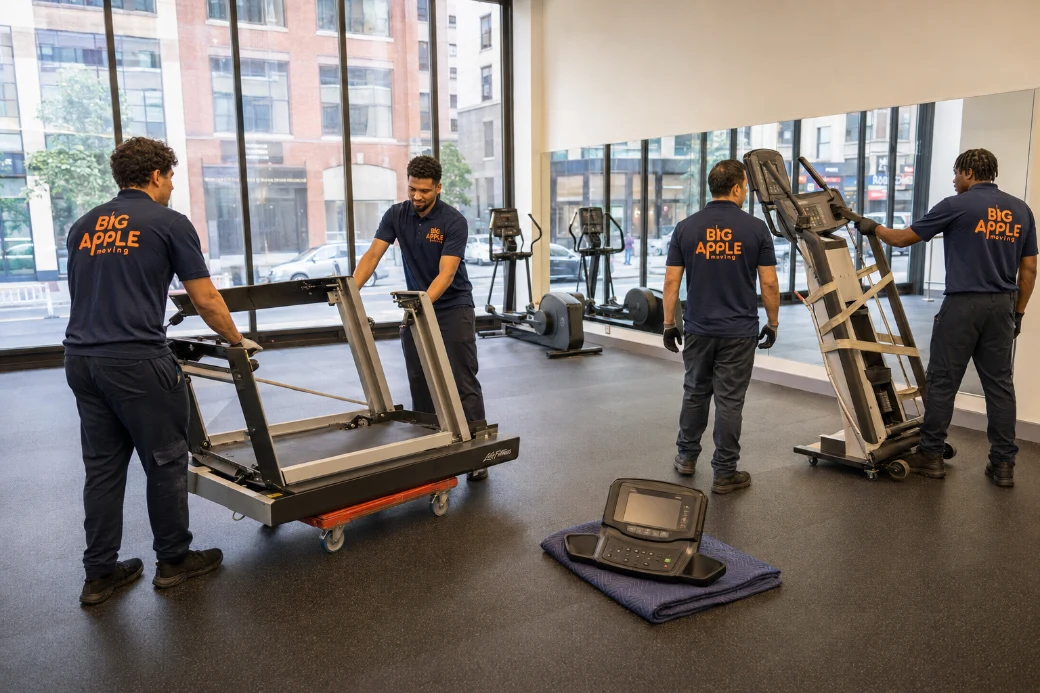
Commercial cardio comes apart. Consoles, side rails and often the deck. Assume every treadmill and elliptical is a disassembly job and the timeline stops being a surprise.
The old equipment has to go somewhere. If you are replacing rather than relocating, our junk removal team clears the old floor in the same visit.
Storage between leases. If the new space is not ready, equipment goes into our storage rather than sitting on a sidewalk. Machines are palletised and wrapped, not stacked.
For a studio floor, send us the equipment list and the new floor plan and we will come back with a sequence and a crew size, not just a rate.
What We Will Not Move
Short section, and the most useful one on the page.

Anything Bolted Into the Building
Wall-mounted Tonals, ceiling rigs, lagged platforms. The manufacturer or a contractor takes it off the structure, then we move it.

A Cracked Frame or a Failed Weld
If a piece is already structurally compromised, moving it is how it fails completely. We will tell you on the survey rather than on the day.

Machines With Full Fluid Reservoirs
Hydraulic rowers and some older resistance machines. Drain them before the day or the move becomes a cleanup.

Anything We Cannot Get a Route For
Rare, but it happens – usually a commercial treadmill in a basement with a spiral stair. We will say so before you book, not after we have taken your deposit.
We would rather lose the booking than take a job we are going to damage your equipment on.
Gym and Fitness Equipment Movers NYC – Frequently Asked Questions
Costs, weights, disassembly, Peloton, Tonal and commercial floors.


