


An international move is two jobs wearing one name. There is the New York end — packing a fourth-floor walk-up, getting a crate down a stairwell, clearing a building’s loading dock inside its elevator window. And there is everything after the port. Big Apple Moving has been doing the first half since 1979, and we manage the second half end to end so you are dealing with one company rather than four.
The New York End of an International Move
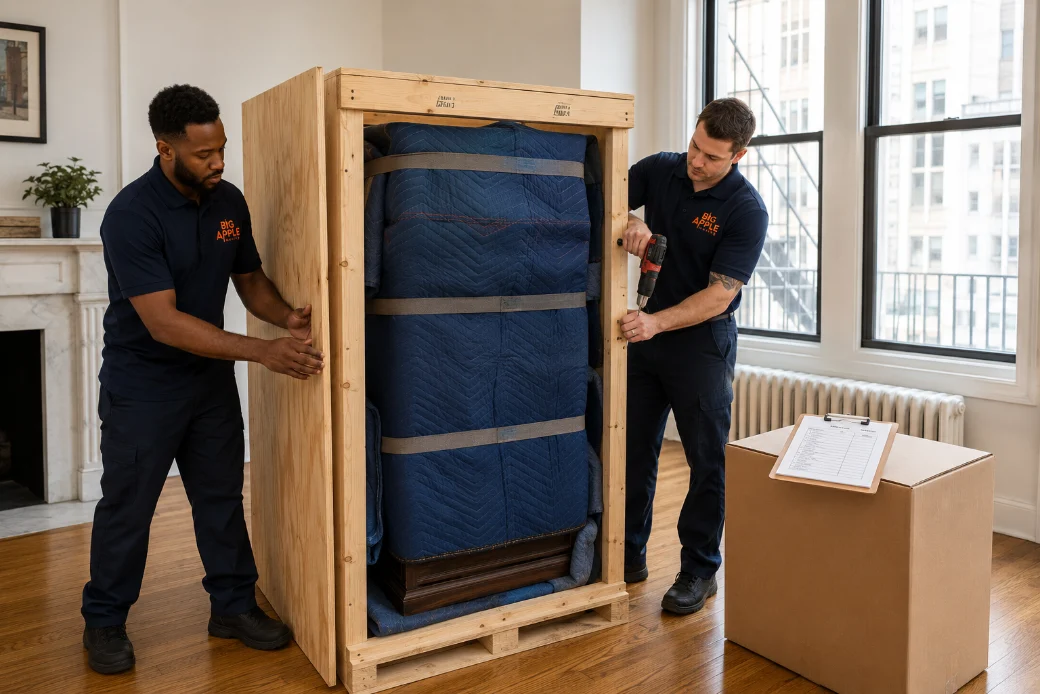
Most international moving companies are freight specialists. They are very good at the ocean leg, and the part that happens inside your apartment is handled by somebody else.
We are the opposite, and it is worth understanding which half of the job you are buying.
What Does It Cost to Move Overseas from New York?
International moves are priced by volume and destination, not by the hour. Here is what that works out to by home size, shipping by sea, door to door.
| Home size | Volume, approx | Typical cost | Door to door |
|---|---|---|---|
| Studio or part load | 150–300 cu ft | $2,500 – $4,500 | 6 – 8 weeks |
| 1 bedroom | 300–600 cu ft | $3,500 – $6,500 | 6 – 8 weeks |
| 2 bedrooms | 800–1,200 cu ft | $6,000 – $9,000 | 6 – 9 weeks |
| 3+ bedrooms, 20ft container | 1,000–1,200 cu ft | $8,000 – $13,000 | 6 – 9 weeks |
| 4+ bedrooms, 40ft container | 2,000–2,400 cu ft | $12,000 – $19,000 | 7 – 10 weeks |
| Air freight, urgent | Any | 3 – 5x the sea rate | 5 – 10 days |
Market-rate estimates for a move from New York, not guaranteed quotes. Your number depends on destination, volume, access at both ends and whether you need storage in between.
Volume is the lever, not the discount. International shipping is sold by the cubic foot. A two-bedroom that ships 1,200 cubic feet costs close to double one that ships 700. Deciding what not to take is worth more than any price you will negotiate, and it is the first conversation we have at the survey rather than the last.
Sea or air is a real choice, not an upsell. Air freight lands in five to ten days against six to nine weeks by sea, and costs three to five times as much. For a full home it is rarely worth it. For the twenty boxes you need in order to start work, it often is — and splitting the shipment is normal.
What is not in the price. Destination customs duties and taxes are set by the country you are moving to, not by us, and are paid by you. Any mover who quotes you a single number that includes foreign duty is guessing.
How Long Does an International Move Take?

Six to nine weeks door to door is the honest answer for sea freight.
Most of that is not the ocean. Here is where the weeks actually go.

Survey to Collection: 1–3 Weeks
Booking, the written estimate, export documentation and a collection date. Longer in June, July and August.

Packing and Collection: 1–2 Days
Export packing and crating at your address, an itemised inventory, then load.

Consolidation and Sailing: 1–3 Weeks
Part loads wait to be consolidated with other shipments. A full container leaves sooner. This is where a shared load saves money and costs time.

At Sea: 3–6 Weeks
Twenty to forty-five days port to port depending on route. Peak season and port congestion add five to ten days.

Customs Clearance: 3–10 Days
At the destination. Straightforward with correct paperwork, slow without it. This is the step where an itemised inventory pays for itself.

Delivery and Unpacking: 1 Day
Delivery to the new address, unpacking, and removal of the packing material where the destination service includes it.
Plan for the gap, not the average. You will be living without your belongings for roughly two months. The practical advice is to air-freight or hand-carry a working set — documents, laptops, a fortnight of clothes, anything you cannot replace locally — and let the rest travel slowly.
How We Run an International Move
What to Check Before You Book Any International Mover
This list is useful whether or not you book with us. If you only do one thing on it, do the first.

Check the FMC Licence
Any company that offers to ship household goods by sea to or from the United States must be licensed or registered with the Federal Maritime Commission. The register is public and searchable at fmc.gov. Check it before you pay a deposit — it is the most useful two minutes you will spend.
Get the Volume in Writing
An estimate without a cubic-foot figure is not an estimate. Volume is what you are being charged for, so it is the number that has to be agreed before anything else.

Ask What the Price Excludes
Destination duties, port storage if your shipment waits, and access charges at the far end are the three that surprise people. A good quote names them even though it cannot price them.

Ask Who Actually Packs
Some quotes cover the freight and treat the packing as somebody else’s job. Ask who will be in your apartment on the day, and who they work for.

Understand the Insurance
Standard carrier liability on an international shipment is minimal and is calculated by weight rather than value. Marine transit insurance is separate, priced on declared value, and worth reading properly rather than ticking.

Be Wary of a Large Deposit
A deposit is normal. A large one requested before a survey has happened is not.
Where New Yorkers Move To
The most common routes out of New York are the UK and Ireland, western Europe, Israel, Australia and Canada. Moving to London from New York is the single most requested route we quote.
Each has its own paperwork and its own quirks. Australia inspects for biosecurity and will hold a shipment over soil on a garden tool. Several European countries require proof of residence before granting duty-free entry on used household goods. We go through the destination’s requirements with you at the survey rather than discovering them at the port.
If you are moving within North America rather than overseas, the long distance movers page covers that instead — it is a road move, priced completely differently.
International Moving from NYC — Frequently Asked Questions
Costs, timelines, customs, insurance and what to check.
Watch Our Customer Stories


