

Get a Free Storage Quote
Why a Business Ends Up Needing Storage
Businesses rarely store things for the sake of it. There is almost always a date and a lease behind it.
A refit means the floor has to be cleared while the work happens. A lease that ends before the new space is ready leaves a gap nobody planned for. A downsize, or a shift to fewer desks, leaves furniture that is too good to throw away and nowhere to put it. Sometimes a landlord hands back a floor at short notice and everything on it has to be somewhere by Friday.
In each case the problem is the same. The furniture has to leave, it has to be looked after, and it has to come back in a usable state.
What Businesses Actually Put Into Storage
Six things account for most of what we hold for businesses, and the order matters. Desks and chairs make up the bulk of the volume; the cabinets and fixtures are what get damaged when a clearance is rushed.
Everything is wrapped on site before it leaves the floor, not at the kerb and not in the lift lobby.
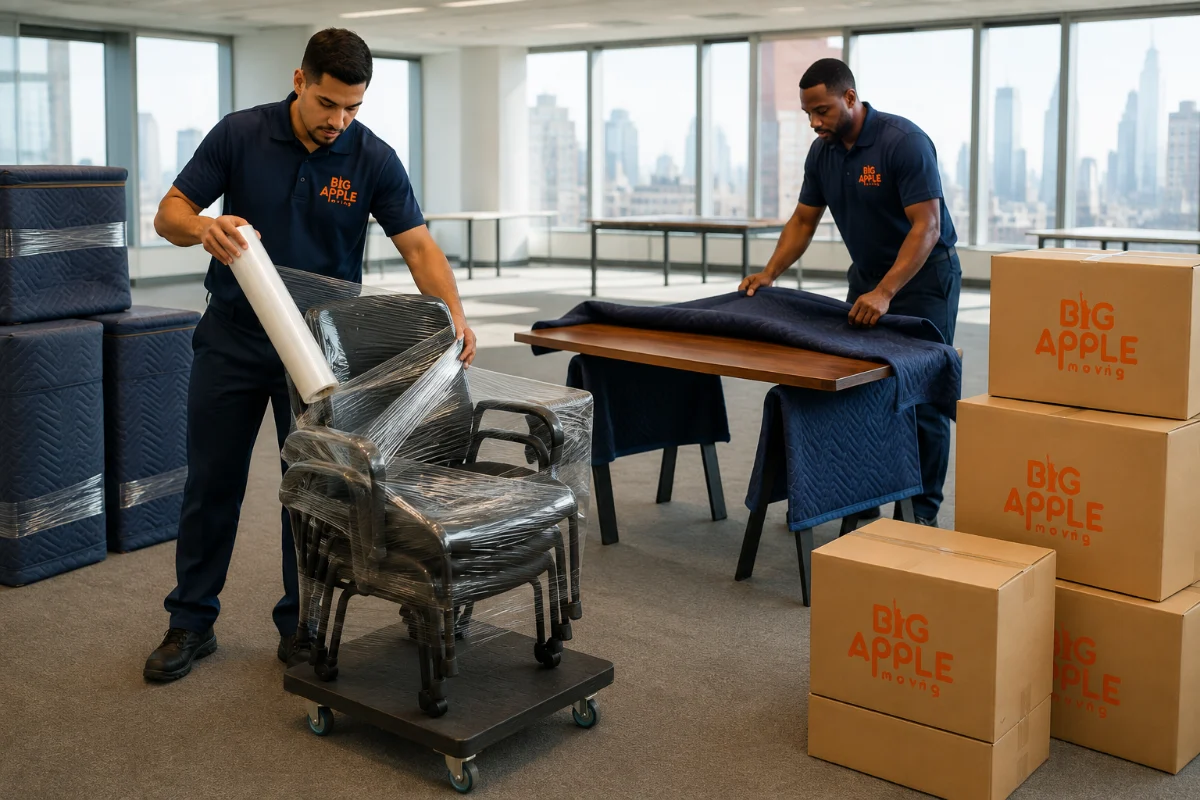

Desks and workstations
Broken down where they come apart, tops padded and stacked. The bulkiest thing in most offices and the reason volume adds up faster than people expect.

Office chairs
Stacked and covered. Chairs are the item most often written off unnecessarily, because they store badly when they are not protected.

Filing cabinets and storage units
Emptied and secured before they move. A loaded cabinet is a damaged cabinet.

Conference and reception furniture
Boardroom tables, sofas, reception desks. Usually the most expensive furniture a business owns and the most worth storing properly.

Fixtures and signage
Shelving, partitions, branded signage and anything else that came out of the fit-out.

Sealed boxes and cartons
Files, stationery, kitchen supplies and the contents of the cupboards, labelled so the far end is not guesswork.
What Your Office Size Means for Storage
Storage is priced by volume, so the useful starting point is how much office you are clearing. These are the standard planning figures the commercial property industry uses, and they are a reasonable way to picture the scale before anyone visits.
| Office layout | Space per person | A 20-person office | What that usually means |
|---|---|---|---|
| High density, open plan | 80–150 sq ft | 1,600–3,000 sq ft | Bench desks, few private offices, most furniture stackable |
| Average density | 150–250 sq ft | 3,000–5,000 sq ft | Mix of desks, cubicles and private offices |
| Low density, private offices | 250–500 sq ft | 5,000–10,000 sq ft | Individual offices, heavier and more individual furniture |
| Individual workstation | 60–110 sq ft open | 80–100 sq ft cubicle | Standard cubicle footprint is 6×6 or 8×8 ft |
Industry planning figures for office space, published as market figures. Floor area is not the same as storage volume — we confirm what you actually have before quoting.
Square footage tells you the scale, not the price. A 3,000 square foot office that is mostly open floor and glass stores very differently from one with forty filing cabinets. We confirm the volume on a walkthrough rather than asking you to estimate it.
Storage That Fits Around a Business Still Running
The hard part of a commercial move is rarely the furniture. It is doing it without stopping the business.
Because we handle the move and the storage together, what leaves the office goes straight into storage rather than being handled twice, and comes back to the new floor when the space is ready rather than when a truck happens to be free. One crew, one inventory, one point of contact for both halves.
Your building will almost certainly want a Certificate of Insurance before anyone touches the freight elevator, and commercial landlords are usually stricter about this than residential ones. We prepare it at no extra charge and deal with the managing agent directly. Read more about Certificates of Insurance for NYC buildings, or about our commercial moving service.
How Commercial Storage Works
The sequence is the same whether you are clearing one floor or three. What changes is how long the walkthrough takes and how much notice the building needs.
Nothing is agreed on a guess. We confirm the volume before you get a number.
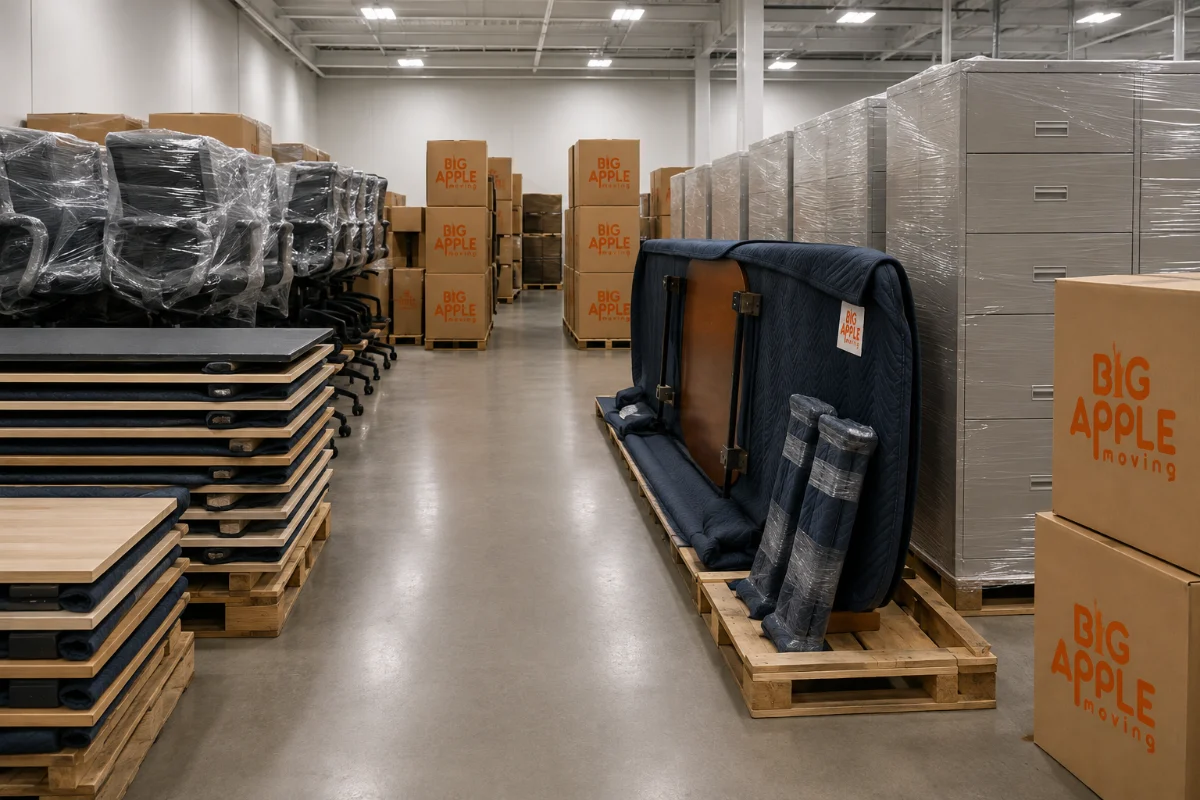
Square footage is a starting point, not a quote. We look at what is actually there and confirm the volume before anything is agreed.
Our own crew, wrapping and breaking down on site. Desks, chairs, cabinets and fixtures all leave protected.
Climate-controlled, priced by volume rather than per desk, with a one-month minimum and basic insurance included.
To the new floor, on your date. Collection and redelivery are quoted with the job, because both depend on volume and building access.
This Is Not a Self-Storage Unit
There is no unit with your company name on the door. For a business clearing a floor that is usually the point, because nobody has to hire a van, book a service elevator twice, or send staff out to a facility on a Saturday.
The trade-off matters more for a business than for a household, so it is worth stating plainly. Because your things are stored by us rather than by you, you cannot drop in and pull out a single box. If your business needs regular access to what it is storing, a self-storage unit is the better fit, and we will tell you that rather than sell you the wrong thing.
For shorter or longer commitments, see short-term storage, long-term storage and full-service storage.
Frequently Asked Questions — Commercial Storage
Storage starts at $50 a month and is priced by volume rather than by the desk or the square foot, so what you pay depends on how much actually goes into storage. Collection and redelivery are quoted alongside it, because both depend on volume and on how easy the building is to work in.
It depends on layout more than headcount. Commercial planning figures put an open-plan workstation at 60 to 110 square feet of floor and a cubicle at 80 to 100, but floor area is not storage volume. A floor that is mostly glass and open desks stores far smaller than one with forty filing cabinets. We confirm the volume on a walkthrough.
Yes. A refit is one of the most common reasons a business calls us. We clear the floor, hold everything while the work runs, and bring it back when the space is ready.
One month is the floor, though most commercial jobs run well past it because they are tied to a build programme rather than a fixed date. You keep the furniture with us for as long as the project takes.
Yes, and that is usually the point. One crew clears the floor into storage and the same service brings it back to the new one, so nothing is handled twice and there is one point of contact for both halves.
Yes, at no extra charge. Send us your building’s requirements or your managing agent’s details and we deal with them directly. Commercial landlords often ask for more than residential buildings do, so it is worth sending the requirements early.
Yes. It matters more than people expect for office furniture, because veneer desks, leather chairs and anything glued react to swings in temperature and humidity rather than to cold itself.
No. Everything is stored together and returned together. If your business needs regular access to what it is storing, a self-storage unit suits you better and we would rather say so.
Basic insurance is included for as long as your things are with us. If you are storing something of unusual value, tell us when you book so we can go through it properly first.
As soon as the date is known. Commercial moves cluster at the end of a quarter and around lease breaks, and freight elevator slots go before the trucks do.
Clearing a Floor?
Tell us the square footage and the dates and we will walk it, then come back with a real number including collection and redelivery.


