


Quick answer: A commercial move in New York City is priced by crew size and hours like any move, but scheduled around your business rather than the calendar — most offices move on a Friday evening or over a weekend so nobody loses a working day. A small office of 10 to 20 staff typically runs $1,800 to $4,000, and a 20 to 50 person office $4,500 to $11,000. We issue the certificate of insurance both buildings will require, and book the freight elevator at each end.
An office move is a logistics problem with a deadline attached. The furniture is the easy part. The hard parts are the freight elevator window at the old building, the certificate of insurance the new building wants before anyone can load, the server rack that cannot be unplugged until Friday at six, and the fact that everyone expects to sit down and work on Monday morning.
Big Apple Moving has run commercial and corporate relocations in New York since 1979 — offices, retail, medical suites, studios and warehouses, from ten-person floors to full-building corporate moves. What follows is how we price them and how we plan them.
What a Commercial Move Costs in NYC
Commercial and corporate work is billed hourly at the same crew rates as residential. What changes is crew size and when the work happens.
| Office size | Staff | Crew | Hours | Typical cost |
|---|---|---|---|---|
| Small office | 10 – 20 | 4 movers | 8 – 12 | $1,800 – $4,000 |
| Mid-size office | 20 – 50 | 6 movers | 12 – 20 | $4,500 – $11,000 |
| Large office | 50 – 100 | 8+ movers | 2 days | $11,000 – $25,000 |
| Retail or medical | varies | 4-6 movers | overnight | quoted per job |
| IT relocation, added to any of the above | — | — | — | $500 – $3,000 |
What moves the number. Weekend or overnight work, which is standard for commercial jobs and priced into the quote rather than added to it. Freight elevator windows, which buildings allocate in blocks — a short window means more crew working in parallel. IT and server equipment, coordinated with your provider. And furniture disassembly, since cubicle systems and modular desking take real time and should be surveyed rather than estimated.
These are market-rate estimates, not guaranteed quotes. The price is set after a walkthrough of both sites. Full hourly rates by crew size are on our hourly movers page.
How We Plan an Office Move
Every office move runs on two things that have nothing to do with furniture: the building paperwork and the labelling system. Get those right and the weekend takes care of itself.
Five steps, and the first two happen weeks before anyone lifts anything:

What We Move for Businesses
Desks and cubicle systems
Modular desking, benching and partitions, disassembled and rebuilt to your new floor plan.
IT and server equipment
Racks, switches, monitors and workstations, crated and moved in coordination with your IT provider.
Filing, archives and records
Moved in sealed crates with a chain of custody, or to storage if the new site has less room.
Retail fit-out and stock
Shelving, displays and inventory, usually overnight so the shop trades both days.
Medical and lab equipment
Moved with the care and documentation those fit-outs require. Tell us what is calibrated.
Art, safes and heavy items
See our fine art movers for gallery-grade work. Safes and oversized machinery are quoted individually.
How We Keep You Trading
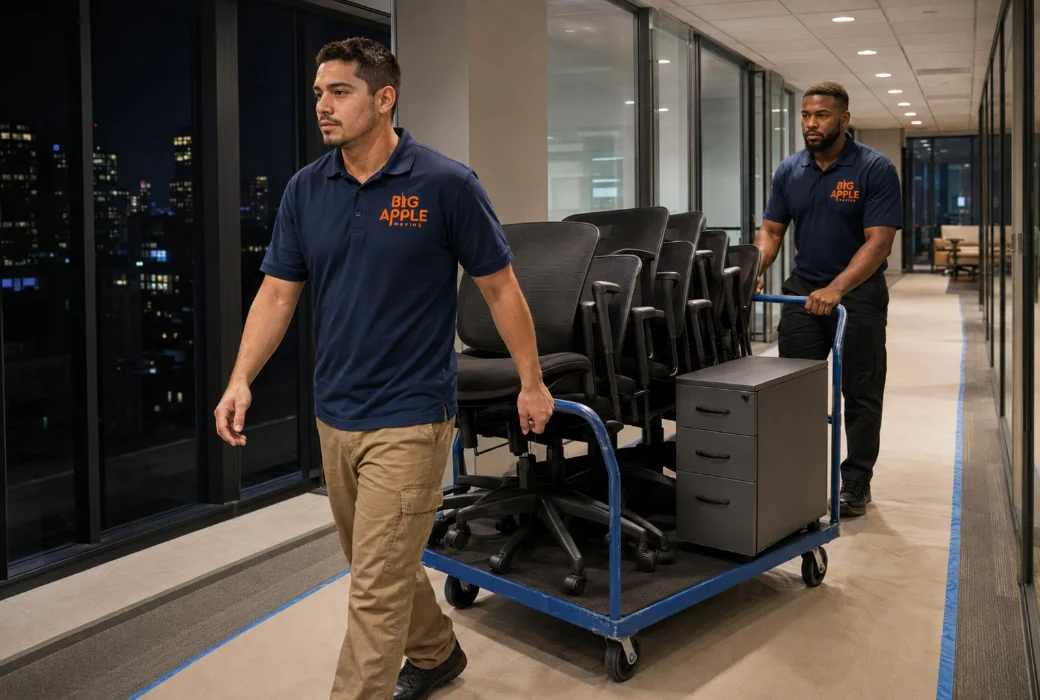
Downtime is the real cost of an office move. The moving invoice is visible; a lost Monday across forty staff is not, and it is usually the larger number of the two.
Four things we do to keep that from happening:
We move outside business hours
Friday evening to Sunday is standard, and overnight moves are routine for retail and medical sites that cannot close.
We move in phases where it helps
Larger offices often move department by department across consecutive weekends so the business never fully stops.
IT goes last and arrives first
Hardware is loaded last and unloaded first, so your IT provider can begin reconnecting while furniture is still being positioned.
Everything is labelled to a plan
Nobody stands in a corridor on Monday wondering which box is theirs, because the crate was labelled to a desk position before it left.
Buildings, Insurance and Freight Elevators
Commercial buildings are stricter than residential ones, and they enforce it. Most require a certificate of insurance naming the building as additional insured, often at $5,000,000 with umbrella cover, before they will release a freight elevator window.
Many also want a signed move-in agreement, proof of workers’ compensation and a scheduled loading dock slot.
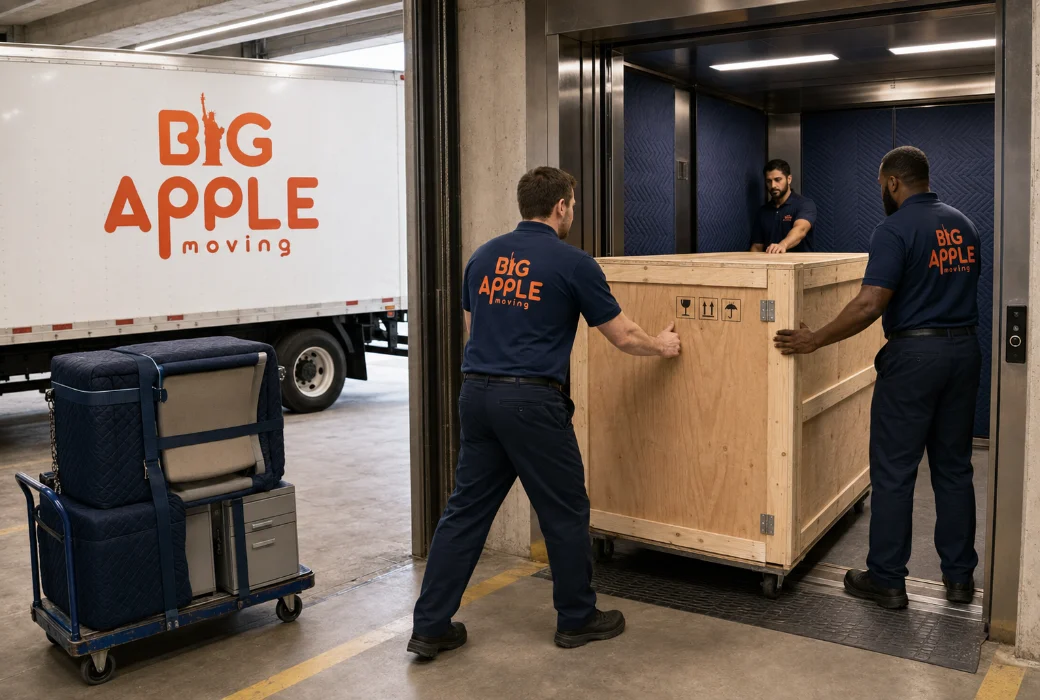
We handle that paperwork as part of the job rather than leaving it with your office manager. Send us the management company details for both buildings when you book and we deal with them directly — see COI movers for how that works. We are USDOT licensed and have operated in New York since 1979, and corporate clients with multiple sites can run all of them through one point of contact rather than booking each move separately.
Moving an office within Manhattan specifically? See office movers in Manhattan.
Planning the project itself? Our office move checklist maps the three months before moving day.
Commercial Moving — Frequently Asked Questions
Costs, scheduling, downtime and building requirements.
Moving a business within Brooklyn? Our guide to commercial moving in Brooklyn covers the borough’s dock-and-curbside reality.
Watch Our Customer Stories


