

When Your Move-Out Date and Move-In Date Do Not Line Up
Leases rarely hand over cleanly. A closing slips a fortnight, a renovation runs long, a new building will not release the elevator until the first of the month. The furniture has to go somewhere, and it has to come back.
This is the ordinary reason a household needs storage, and it is the one most storage pages skate past. Your things are collected by our crew, held, and brought to the new address when the date is finally real. You are not renting a unit and hiring a van twice.
Because we do the move as well as the storage, your belongings are handled once at each end rather than loaded, unloaded and loaded again.
How Much Storage Does an Apartment Actually Need?
Storage is priced by volume, so the useful question is how many cubic feet you have. Almost nobody publishes the answer. These are industry estimates for a furnished home, and they are close enough to plan with.
Household goods run to roughly seven pounds per cubic foot, which is how volume converts to weight on an estimate. You do not need to work any of this out yourself — we confirm it when we quote.
| Home size | Rough volume | Self-storage equivalent | What that looks like |
|---|---|---|---|
| Single room of furniture | 150–200 cu ft | 5×5 unit | One room’s furniture plus 15–20 boxes |
| Studio | 200–400 cu ft | 5×10 unit | Sofa, bed, dresser, TV stand, 20–25 boxes |
| One bedroom | ~500 cu ft | Between 5×10 and 10×10 | Living room set, bedroom set, small dining table, 30–40 boxes |
| Two bedrooms | ~800 cu ft | 10×10 unit | Two bedrooms plus a family room |
Industry estimates for a furnished home, drawn from moving-estimator guides and self-storage size guides. Your own volume depends on how much you own — we confirm it when we quote.
What Goes Into Residential Storage
Most of what we hold is ordinary household furniture, and most of it needs wrapping rather than special handling.

Sofas and upholstery
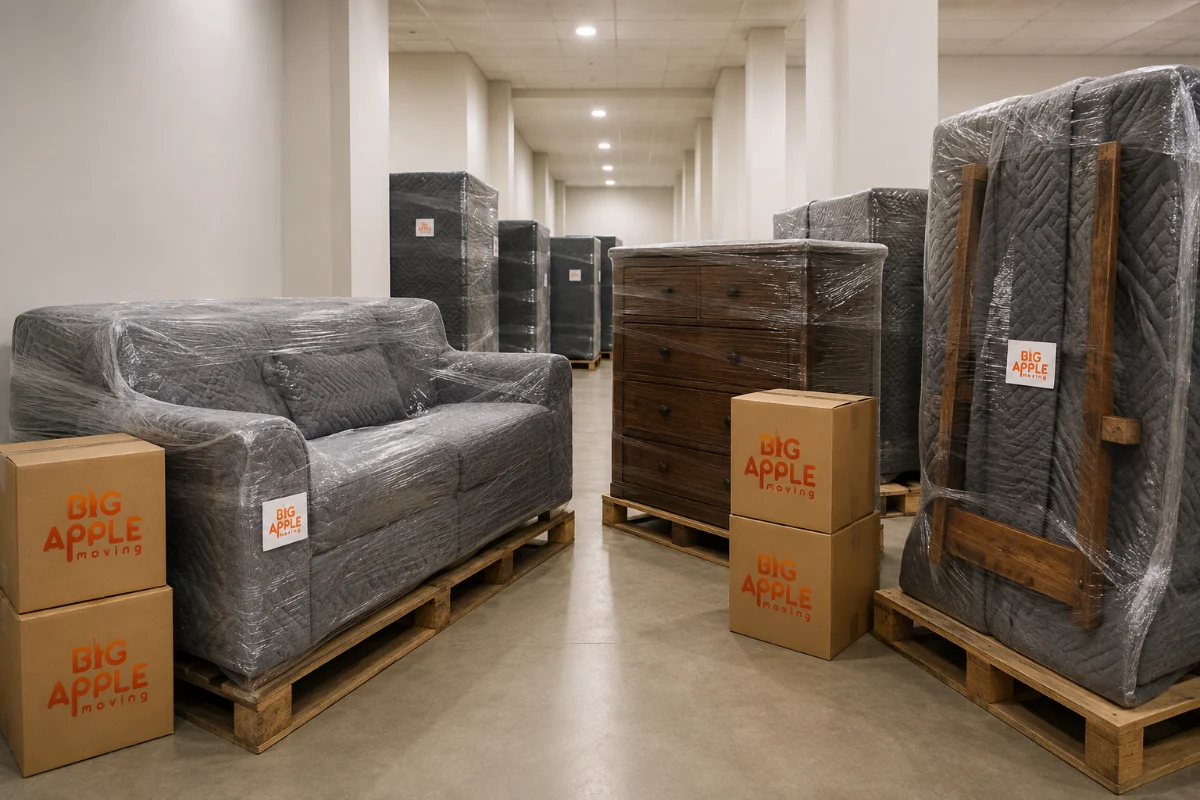
Blanket-wrapped and covered before they leave the apartment, because fabric picks up dust and marks far more easily than wood.

Beds and mattresses
Frames broken down, mattresses bagged. A mattress stored flat and covered comes back in the condition it left in.

Dining tables and chairs
Legs off where they come off, tops padded and stacked so nothing rests on a polished surface.

Wardrobes and dressers
Emptied, drawers secured, corners protected. Drawers left full are how furniture arrives damaged.

Boxes and cartons
Kitchens, books, clothes and paperwork. Labelled by room so unpacking at the far end is not guesswork.

Rugs and artwork
Rolled rather than folded, wrapped, and kept up off the floor.
Why Conditions Matter More Than People Expect
Our storage is climate-controlled, and for furniture that matters more than most people expect. It is not about cold. Wood joints, leather, veneer and anything glued react to swings in temperature and humidity, and a New York summer in an uncontrolled space is harder on a dining table than a New York winter.
What that looks like in practice: joints loosening as glue expands and contracts, veneer lifting at the edges, leather drying or going tacky, and upholstery holding damp long enough for a smell to set in. None of it happens in a week. All of it happens over a season.
If you are storing anything wooden, upholstered or leather for more than a few weeks, this is the question worth asking any storage company — and it is worth noticing who answers it.
How Residential Storage Works
Storage works the same way a move does, because it is one. You tell us what you have, our crew comes and wraps it, it sits with us for as long as you need, and it comes back when your new address is ready.
The only part that needs thought from you is the date range. The cartons, the blankets, the lifting and the paperwork your building asks for are all on our side.

Room counts and the big pieces are enough to start. We confirm the volume before anything is agreed.
Our own crew, wrapping everything before it leaves the apartment. Nothing is packed at the kerb.
Your belongings stay together and stay ours to look after. Storage starts at $50 a month with a one-month minimum, and basic insurance is included.
To your new address, when your date is confirmed. Collection and redelivery are quoted with the job, because both depend on volume and access.
This Is Not a Self-Storage Unit
There is no unit with your name on it and no key on your keyring, and for most households that is the point. You are not driving to a facility, not paying for a van twice, and not carrying a wardrobe down a flight of stairs on a Saturday.
The trade-off is real and worth stating plainly: because your belongings are stored by us rather than by you, you cannot drop in and pull out a single box. If you know you will need regular access to individual items, a self-storage unit is the better fit and we will say so.
If your dates are short, or open-ended, we have pages for both: short-term storage, long-term storage, and full-service storage.
Frequently Asked Questions — Residential Storage
Storage starts at $50 a month. What you actually pay depends on how much you are storing, because storage is priced by volume rather than by the room. Collection and redelivery are quoted alongside it, since both depend on how much there is and how easy the building is to work in.
Roughly 500 cubic feet, on industry estimates for a furnished home — somewhere between a 5×10 and a 10×10 self-storage unit. A studio is usually 200 to 400 cubic feet. We confirm your actual volume before quoting rather than asking you to guess.
One month. After that you keep your belongings with us for as long as you need them there.
No. Your belongings are stored together and returned together. If you know you will need to reach individual items during the storage period, a self-storage unit suits you better, and we would rather say that than sell you the wrong thing.
Basic insurance is included for as long as your things are with us. If you are storing something of unusual value, tell us when you book so we can go through it properly beforehand.
We collect. Our own crew comes to the apartment, wraps everything there, and takes it away. When your new place is ready, the same service brings it back.
A self-storage unit is space you rent and fill yourself, with your own key and your own van. This is a service — we collect, wrap, store and return. You trade daily access for not doing any of the lifting.
We handle the wrapping. What helps is emptying drawers and wardrobes, since furniture stored with drawers full is the most common way pieces get damaged, and telling us about anything fragile, valuable or awkward before the day.
As long as you need. One month is the minimum; beyond that there is no maximum, and plenty of households store for a season or longer while a renovation or a sale runs its course.
Yes. Boxes, cartons, rugs, artwork and the ordinary contents of a home all go into storage alongside the furniture. There are some things we cannot take, so ask us before the day if you are unsure about anything in particular.
Storing Between Two Addresses?
Tell us the rooms and the dates and we will come back with a real number, including collection and redelivery.


