

A Chinatown move is a stair-and-street problem before it is a distance problem. The neighborhood’s predominant building type is the walk-up tenement — typically five or six storeys with no elevator — its core packs more than 6,000 businesses into roughly 50 blocks, and one street, Doyers, is now a pedestrian plaza entirely. A serious estimate counts the flights, plans where the truck legally stands while storefront deliveries run around it, and prices the carry rather than the mileage. At market rates, most Chinatown studio and one-bedroom moves land between $400 and $1,100.
What a Chinatown Move Costs
Chinatown pricing is decided on the stairs. Much of the neighborhood was built before elevators were required in housing at all, so the honest question in any estimate is not how far the truck drives — it is how many flights stand between your door and the curb, and what is happening on that curb when the crew arrives. The ranges below are 2026 Manhattan market estimates by home size; movers in this market commonly add stair fees of $50–$75 per flight, which is why our written estimate prices your building’s access up front instead of surprising you per step. There is no minimum number of hours on any Big Apple Moving job, and a single guaranteed price for the full job can be agreed in writing instead.
| Move Size | Typical Inventory | Market Estimate | Estimated Time |
|---|---|---|---|
| Studio | Tenement walk-up studio | $400–$800 | 2–4 hours |
| 1 Bedroom | One-bedroom walk-up, third floor or higher | $500–$1,100 | 3–5 hours |
| 2 Bedroom | Two-bedroom tenement or elevator co-op | $900–$1,800 | 5–8 hours |
| 3 Bedroom | Full-floor family apartment | $1,300–$2,800 | 7–12 hours |
Note: Manhattan 2026 market estimates, not a quote. Flights of stairs and the curb situation move the number more than anything else here. Contact us for a written estimate for both addresses.
Crews Built for Stairs and Tight Blocks

No Minimum Hours
Many Chinatown apartments are compact — when the job is short, the bill is short. We bill the job, never a minimum.

COI Same Business Day
Where a managed building requires a Certificate of Insurance, it is issued, named and filed the same business day, free.

5.0 Stars · 2,300+ Reviews
A perfect Google rating across more than 2,300 verified customer reviews.

Since 1979 in NYC
More than 220,000 moves, in every kind of building New York has ever built — including the ones with no elevator and five flights.

NY DOT #T-9942
Active New York State Department of Transportation authority. Documentation available on request.

Booking 24/7
Book around the clock, with support 7AM–9PM — and the truck plan settled before move day, not on it.
Moving Services in Chinatown


Small Moves
Compact apartments mean compact jobs — a few pieces up or down five flights is still real work.




A Neighborhood Built Before Elevators
The federal record puts it plainly: the predominant building type in Chinatown is the tenement — mid-1800s to early-1900s housing, typically five or six storeys of walk-up stairs. The stairwells are narrow, the turns are tight, and the difference between an old-law and a new-law building is the difference between a straight carry and a negotiation. Not every address fits the pattern, but enough do that a Chinatown estimate is built around the flights, floor by floor.
The contrast makes the point: Confucius Plaza, the 44-storey tower at Bowery and Division with 762 apartments, is one of the neighborhood’s few residential high-rises — and managed elevator buildings like it move the way managed Manhattan buildings do, with a Certificate of Insurance and a booked elevator window. One neighborhood, two completely different move days. We crew for the one you actually live in.

Four Decisions Before the First Box
Floor, stairwell shape and any elevator at either end go into the estimate first — access is the price here, so it is measured, not guessed.
Doyers is a pedestrian plaza, and the busy blocks fill with storefront deliveries by morning. The truck’s legal position — and the carry from it — is settled in advance.
Narrow halls, worn banisters and shared entries get padding and runners; furniture that should come apart comes apart before the stairs, not on them.
Loaded, driven, delivered and reassembled in the same day for local jobs — with the written price agreed before any of it started.
Trucks, Storefronts and the Busiest 50 Blocks Downtown
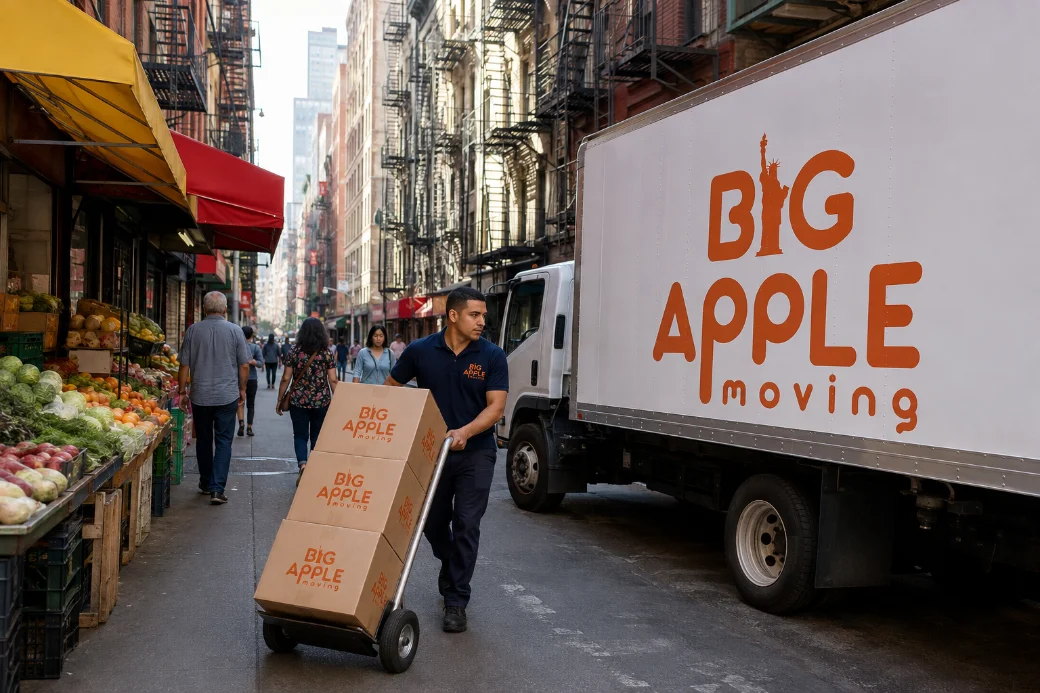
Chinatown’s core squeezes more than 6,000 businesses into roughly 50 blocks — which means a moving truck shares every curb with produce deliveries, restaurant supply runs and the daily commerce of one of the densest retail neighborhoods in Manhattan. Add streets the city itself calls unusually narrow, one converted to a pedestrian plaza outright, and the Manhattan Bridge approach cutting through at Canal and Bowery, and the truck plan stops being an afterthought.
It is also all inside Manhattan’s congestion zone, where trucks pay to enter below 60th Street — one more line a serious estimate includes rather than adds later. From Canal down to Two Bridges by the river, the blocks change character fast; tell us both addresses and the plan comes back in writing, curb to curb.
Chinatown Moving — Frequently Asked Questions
At 2026 Manhattan market rates, a Chinatown studio typically runs $400–$800, a one-bedroom $500–$1,100, a two-bedroom $900–$1,800, and a full-floor family apartment $1,300–$2,800. Stairs drive the spread — most of the neighborhood is walk-up housing — and movers in this market often add $50–$75 per flight. Our written estimate prices the flights up front instead; there is no minimum number of hours.
In this market, commonly yes — per-flight stair fees are standard practice. We handle it differently: the flights are counted into the written estimate before you book, so a fifth-floor tenement job is priced as exactly that from the start, with no per-step arithmetic on move day.
It depends on the building. Smaller walk-ups often ask for nothing, while managed buildings and elevator towers require a COI naming the building before the move is approved. When yours does, we issue and file it the same business day at no charge — send your management’s contact when you book.
Wherever posted rules allow — no permit reserves a curb for a household move in New York, and Doyers is a pedestrian plaza. The plan is made street by street: commercial loading zones and legal positions as close as the block allows, timed around delivery traffic, with the carry distance priced into the estimate rather than discovered on the day.
Count the flights: a studio two floors up moves in a couple of hours; a full one-bedroom on a fifth floor is honest work at three to five. The stairwell, not the street, sets the pace — which is why the estimate asks about your floor before anything else.
Yes — commercial moves are part of the daily work here, scheduled around the block’s own delivery rhythm and, where the business needs it, outside trading hours. Equipment, stock and fixtures travel wrapped and inventoried, with the same written pricing as any move.
Yes — from Canal Street down through Two Bridges by the river, and across the surrounding downtown blocks. The buildings shift from tenement walk-ups to tower blocks within a few streets, and the estimate reflects whichever end of that range you are on.
A week or two ahead is comfortable for most walk-up jobs; month-end and weekends go first. Elevator buildings need their window reserved with management, which adds lead time. Booking is open around the clock, and a written estimate locks both the date and the price.


