

Hiring movers in Harlem typically runs $800–$1,100 for a local one-bedroom at 2026 market rates, and the stairs matter more than the miles — much of Central Harlem’s housing between 110th and 155th Street is pre-war brownstone and walk-up stock with no elevator. Big Apple Moving has been carrying Harlem stoops since 1979, billed hourly from $150 for two movers and a truck with no minimum hours, or as a binding estimate agreed in writing. One street rule worth knowing: the 125th Street bus lanes are camera-enforced, so the truck stands in a legal side-street spot while the crew works — planned before move day, never improvised.
What Moving in Harlem Costs
A Harlem move is priced by access more than distance. A third-floor brownstone walk-up with a narrow 1890s stairwell takes crew time a doorman elevator building never asks for, and a serious estimate is built around the stairs, the stoop and the legal parking — not the mileage. The ranges below are 2026 market estimates for local moves; Big Apple Moving bills hourly from $150 for two movers and a truck with no minimum hours, or agrees a single binding price in writing before the day.
| Move Size | Typical Harlem Home | Market Estimate | Main Cost Driver |
|---|---|---|---|
| Studio | Prewar studio or SRO-conversion unit | $400–$800 | Stairs and carry distance |
| 1 Bedroom | Walk-up one-bedroom | $800–$1,100 | Flights of stairs |
| 2–3 Bedroom | Floor-through brownstone apartment | $1,100–$2,400 | Stoop and stair carries |
| Full brownstone | Owner’s triplex or full house | $2,400–$4,300 | Crew size and hoisting |
Note: Market estimates, not a quote — 2026 market data puts NYC local moves anywhere from $495 to $4,334, and in Harlem the flights of stairs decide where in that band a move lands. Send both addresses for a written estimate.
Built for Stairs, Stoops and Street Rules

Walk-Up Crews
Crews sized for elevator-free buildings — the fourth floor is planned for, not discovered on the day.

COI Same Business Day
Condos and managed buildings on the new Frederick Douglass corridor need a Certificate of Insurance — issued, named and filed the same business day, free.

5.0 Stars · 2,300+ Reviews
A perfect Google rating across more than 2,300 verified customer reviews.

Since 1979 in NYC
More than 220,000 moves across the five boroughs — Harlem stoops included from the start.

No Minimum Hours
Small Harlem moves stay small — we bill the job, not a minimum.

Binding Estimate in Writing
One written price for the whole job before the truck rolls — the stairs are in the number, not a surprise after it.
Moving Services in Harlem



Moving in Harlem’s Historic Districts
Central Harlem’s brownstone core is protected block by block. The St. Nicholas Historic District — Strivers’ Row — went up between 1891 and 1893 with architects including Stanford White, and its houses share something almost nothing else in Manhattan has: rear service alleys behind the row. Mount Morris Park Historic District covers sixteen landmarked blocks whose housing stock largely dates from 1880 to 1900. Beautiful to live in; particular to move in. Parlor floors arrive by stoop, stair railings and newel posts predate the sectional sofa by a century, and the top floor is always a carry.
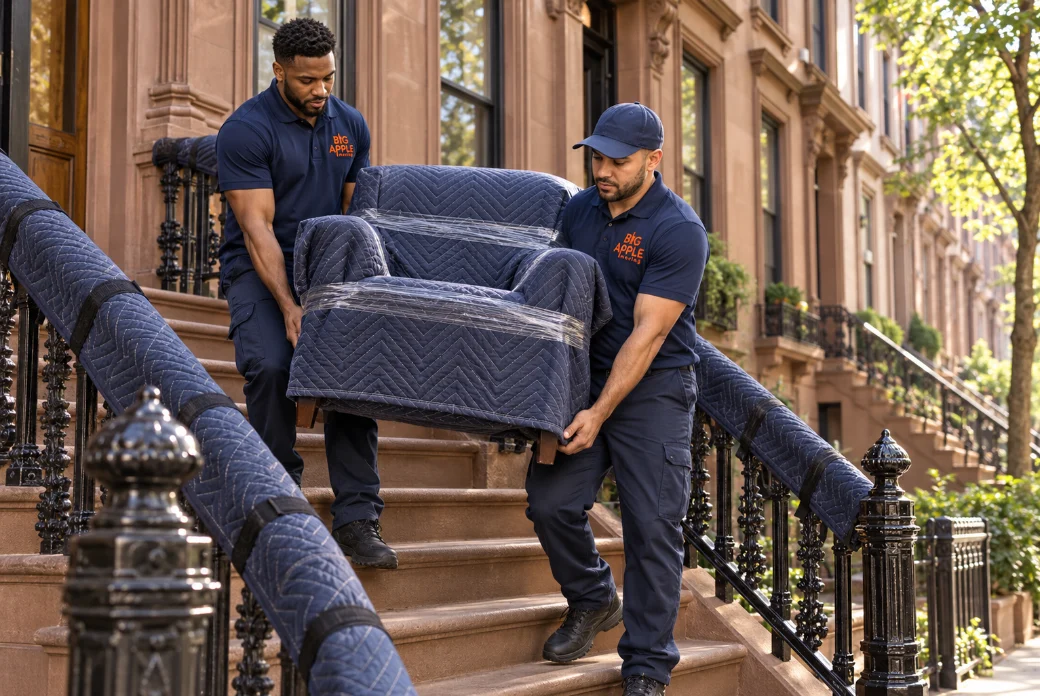
We plan those moves around the building, not against it: padding on the stoop rails, floor protection over original parquet, crews sized for the flights, and hoisting only when a piece genuinely will not make the turn. Since 1979 the answer to a narrow 1890s stairwell has been preparation, not force.
Harlem, Block by Block
Mount Morris Park
Sixteen landmarked blocks off Lenox — parlor-floor pieces come down the stoop, and we pad the rails first.
Strivers’ Row
The 1891–93 St. Nicholas district, with Manhattan’s rare rear alleys — sometimes the smarter load-out.
Sugar Hill
Sugar Hill’s apartment houses climb the ridge — elevator buildings with freight rules worth booking early.

Hamilton Heights
Rowhouse blocks around City College; narrow stairs, tight turns, crews that know both.

West Harlem & Manhattanville
From the Hudson viaducts to Morningside’s border — walk-ups, new towers and everything between.

The 125th Street Corridor
Harlem’s main street has its own rules on move day — covered in the next section.
The 125th Street Rules Nobody Mentions
125th Street runs 2.3 miles of camera-enforced bus lanes, ticketed automatically since 2016 at $115 per violation — and the MTA’s bus-mounted cameras now also ticket vehicles double-parked along bus routes. A moving truck that “just stops for a minute” on Harlem’s main street collects fines by machine. That is a planning fact, not a scare: the legal standing spot is scouted on the side street before the crew rolls, and the carry is priced honestly instead of parked illegally.
The rest of the grid is friendlier. The 2 and 3 run under Lenox and the A, B, C and D under St. Nicholas — useful on moving week when one car stays behind — and Metro-North’s Harlem–125th Street station anchors the east end of the corridor. Central Harlem is compact: about 130,000 residents on roughly a mile and a half square between Central Park and the Harlem River, which is why crews that work it daily know which blocks load easily and which need a plan.
Moving in East Harlem
East of Fifth Avenue the housing changes — East Harlem is tenement walk-ups, Lexington Avenue towers and more than twenty NYCHA developments, and Big Apple Moving is an approved NYCHA and HRA vendor for those moves. That side of Harlem has its own page: see our East Harlem movers guide for market pricing and building specifics from 96th to 138th Street.
Harlem Moving — Frequently Asked Questions
At 2026 market rates a local one-bedroom move in Harlem typically lands between $800 and $1,100, a studio between $400 and $800, and a floor-through brownstone apartment between $1,100 and $2,400. Stairs set the price: every elevator-free flight adds crew time. Big Apple Moving bills hourly from $150 for two movers and a truck with no minimum hours, or agrees a binding estimate in writing for the whole job.
Daily. Much of Central Harlem’s stock between 110th and 155th Street predates elevators, so crews are sized for the flights before the day — more movers, not more hours of two people on a staircase. Stoop rails and newel posts get padded, floors get protected, and genuinely oversized pieces are measured for the stairwell turn before anyone lifts them.
Not in the bus lanes — 125th Street carries 2.3 miles of camera-enforced lanes, ticketed automatically at $115, and bus-mounted cameras now ticket double-parking along the route as well. The crew scouts a legal standing spot on the side street beforehand and plans the carry from there, so the truck never sits where a machine writes tickets.
If either end is a condo, co-op or managed rental building — including the newer elevator buildings along Frederick Douglass Boulevard — almost certainly. We issue and file COIs naming the building and its managing agent the same business day, free. Private brownstone owners usually skip the paperwork entirely.
Yes — a landmark designation restricts what owners may alter, not whether you may move in. What it means in practice is care: the 1891–93 Strivers’ Row houses and the 1880–1900 Mount Morris stock have original railings, parquet and plasterwork, so everything is padded and protected. Strivers’ Row’s rear alleys — rare in Manhattan — occasionally offer a better load-out than the stoop.
All of them: Central Harlem from 110th to 155th, Mount Morris Park, Strivers’ Row, Sugar Hill, Hamilton Heights, and West Harlem through Manhattanville. East of Fifth Avenue, East Harlem has its own dedicated page — that side is tenement and NYCHA territory, where Big Apple Moving is an approved NYCHA and HRA vendor.
As soon as the lease or closing date is firm. Month-end dates fill first across the city, and brownstone closings cluster seasonally; walk-up crews are also the ones every Harlem job wants, so the earlier the date locks, the better the crew fit. A written estimate holds the plan together.
Yes — with no minimum hours, a studio or single-room move stays a small job at a small price. Single large pieces work the same way: one sofa down four flights is a real job for two movers and a truck, and it is billed as exactly that.
Yes. Between a sale and a closing, or a lease gap of a week or a season, moves go into climate-controlled storage and come back on your date — one crew, one bill, no self-storage van rental in the middle.
Constantly — Harlem to Westchester and the suburbs is a one-day run, and longer routes out of New York are handled by the same company end to end. Start with the long-distance page for named routes, or send both addresses and we will route it properly.


