

Moving a slate pool table requires full disassembly, protected slate transport, careful reassembly and precision leveling at the destination. Big Apple Moving provides pool table relocation across all five boroughs, including walk-ups, brownstones and buildings with freight-elevator and COI requirements.
Most local moves take approximately 4–8 hours, depending on table construction, route and building access.
What Is Included in Pool Table Moving?

Table & Access Assessment
We review table size, slate type, building access and COI requirements before scheduling crew and equipment.

Full Disassembly
Pockets, rails and felt removed first. The felt is rolled carefully — most cloth can be reused at the destination.

Component Labeling
Every rail, bolt and hardware piece is bagged and labeled so reassembly follows the original configuration exactly.

Felt Protection
Felt is rolled under tension and stored separately during transport to preserve its shape and stitching.

Individual Slate Wrapping
Each slate section wrapped in moving blankets and secured upright. Slates never lie flat on top of each other in the truck.

Protected Transportation
Dedicated vehicle. Nothing stacked on the slate. Pool table moves do not share a truck with other jobs.

Frame & Slate Reassembly
Frame, legs and slates reinstalled in sequence — shimmed to the sub-floor, seams prepared before leveling.

Precision Leveling
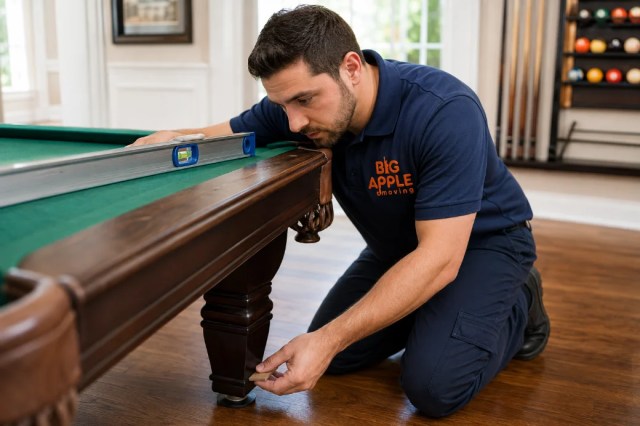
Precision level checked at multiple points across the slate surface. The table is not finished until the level reads flat.

Final Playing-Surface Check
Ball roll confirmed before the crew leaves. Refelting, repairs and storage can be added when needed.
The Slate Problem: Why Pool Table Moving Is a Specialty Service
The slate is what separates a pool table from every other piece of furniture you own. It is a slab of precision-ground stone — up to 250 lbs per piece for a 3-piece table, or as much as 1,000 lbs for a vintage 1-piece — and it has to arrive at the destination without a crack, a scratch, or a degree of tilt.
Cracks, chips or improper support can compromise the slate and affect whether it can be safely reinstalled. Moving a slate table intact can damage the slate, frame or joints. Even a small leveling error can cause inconsistent ball roll across the playing surface. That is why every pool table move ends with re-leveling — checking the slate at multiple points with a precision level and shimming until it reads flat.

How We Move Your Pool Table
We review table size, manufacturer, slate construction, stair flights, elevator availability, COI requirements and felt condition before arriving. This is how we confirm crew size, equipment and timing in advance.
Pockets, rails and felt removed first. The felt is carefully rolled and packed — most felt can be reused. Then the slates are unseated from the frame.
Each slate wrapped individually in moving blankets and secured upright in the truck. Slates never lie flat on top of each other. Dedicated vehicle — no shared loads.
Dedicated vehicle, nothing stacked on the slate sections. Pool table moves do not share a truck with other jobs.
Frame, legs and slates installed in sequence — shimmed to the sub-floor, not just set down. Seams prepared before leveling begins.
Precision level checked at multiple points across the slate surface. The table is not done until the level reads flat.
Pool Table Sizes and What They Weigh
7 ft (Bar Box)
3-piece slate | 500–700 lbs assembled | Standard in bars and smaller apartments. The most maneuverable size on stairs.
8 ft (Home Standard)
3-piece slate | 700–900 lbs assembled | The most common residential size in New York City homes.
9 ft (Tournament)
3-piece slate | 900–1,200 lbs assembled | Requires freight elevator or ground-floor access in most NYC buildings.
Vintage / Antique
1-piece slate | 800–1,400 lbs | The heaviest and most fragile. Tell us the make and year when you book.
How Much Does It Cost to Move a Pool Table in NYC?
Published market prices vary primarily by table size and slate construction, but stairs, elevators, long carries, distance, felt condition and specialty setup requirements can also affect the final cost.
| Table or service | Typical 2026 NYC market estimate |
|---|---|
| 7-foot slate table, typical local move | $350–$600 |
| 8-foot slate table, typical local move | $450–$750 |
| 9-foot tournament table | $550–$950 |
| Antique or one-piece slate table | $700–$1,500+ |
| Walk-up access | Often adds $50–$150 per flight |
| Refelting during setup | Approximately $250–$500 |
| Difficult access, rigging or long distance | Custom estimate |
Estimates reflect publicly available 2026 NYC market data. Contact us for a quote based on your specific table and building.
Stairs, Elevators and Tight Spaces: NYC Pool Table Moving
Pool tables and NYC buildings do not naturally agree. Walk-up buildings: each slate section is carried separately — 150–250 lbs per piece — which is manageable down a flight, but tight staircase turns are the real constraint. A 9-ft slate section measures roughly 5 ft × 4.5 ft. We measure the turn at the first landing before booking to confirm it is feasible.
High-rise buildings: the freight elevator must be booked in advance, and most co-ops and condos require a certificate of insurance naming the building as additionally insured. We issue COIs the same business day. Ground-floor apartments are the easiest access scenario. Basement recreation rooms require confirming stairwell dimensions when you book — a pool table that went in during construction may not come out the same way.

What a Pool Table Move Looks Like
The following represents a typical pool table move we handle in New York City. Details like building type, access conditions and table configuration vary — this example shows how those factors affect the job.
Table: 9-foot Brunswick Gold Crown, three-piece slate (approximately 900 lbs assembled)
Origin: Park Slope, Brooklyn — brownstone, third-floor walk-up
Destination: Upper West Side, Manhattan — pre-war co-op, freight elevator
Access at origin: Three flights, tight turn at the second landing — three-person crew. COI issued same business day. Freight elevator reserved 10 a.m.–2 p.m. window.
Work performed: pre-move assessment confirmed table dimensions and building access. Disassembly with felt rolled and reserved for reinstallation. Slates wrapped individually and secured upright. Dedicated vehicle. Reassembly with slates shimmed to the sub-floor. Six-point level check — minor shimming at one corner. Felt reused. Duration: approximately 7 hours. Ball roll confirmed before crew left.
Pool Table Moving — Frequently Asked Questions
Everything you need to know about moving a pool table in New York City.
Published 2026 market estimates commonly range from about $350 to $950 for a standard local pool table move. Antique or one-piece slate tables, walk-up stairs, refelting, rigging and longer-distance transportation may increase the cost to $1,000–$1,500 or more. These are general market estimates, not a Big Apple Moving quote. Contact us for pricing based on your table and move conditions.
Yes. Any table with a slate bed must be fully disassembled for safe transport. Moving a pool table intact risks cracking the slate — the heaviest and most expensive component — and makes the table impossible to level properly at the destination.
Not safely. Slate tables require full disassembly, individual slate wrapping, upright transport and precision re-leveling — equipment and procedures that differ from standard furniture moving. Attempting to move a slate table intact, or without precision leveling equipment, risks cracking the slate and leaving the table unplayable.
Most local moves take 4–8 hours from assessment and disassembly through to re-leveling. Walk-up buildings or cross-borough routes add 1–2 hours depending on access conditions.
Yes. We handle walk-up buildings across all five boroughs. Each slate is disassembled and carried separately, which reduces the weight per carry to 150–250 lbs. We will confirm the staircase dimensions before booking to make sure the turn is feasible.
If you are in a co-op, condo or managed rental, most NYC buildings require a COI naming the building as additionally insured before a crew enters. We issue certificates the same business day at no charge.
The felt is removed carefully during disassembly and reinstalled during reassembly. Most felt survives a move without damage. If the cloth is worn and you want to replace it during the move, ask when you book.
After reassembly, the slate must be shimmed to be perfectly flat. If it is off-level by even a small amount, every shot drifts to one side. We check with a precision level at multiple points before the job is complete.
Yes. We move 7-ft bar tables, 8-ft home tables, 9-ft tournament tables and vintage single-slate antique tables. Antique and non-standard tables should be described in detail — including make, year and slate construction — when booking, so we can confirm crew and equipment requirements.
Table size, manufacturer, one-piece or three-piece slate, origin and destination addresses, number of stair flights, elevator availability and COI requirements. Felt condition and any refelting request are also helpful. The more detail you provide, the more accurate the estimate.
Yes. Same-building moves — floor-to-floor or unit-to-unit — are handled with the same disassembly and leveling process as any other pool table relocation.


