

An Aquarium Move Has Two Parts
A fish tank needs two coordinated moves: one for a fragile glass or acrylic container and another for the animals that live in it. The crew needs a clear carry route; the fish need a suitable transport environment and a ready destination. Planning those jobs together prevents the tank from arriving after the livestock has run out of suitable holding options.
This guide explains how to move a fish tank with a moving crew, what the owner prepares and how NYC stairs, service elevators and delivery timing affect the plan. Moving plants too? See how we move plants for that separate part of your household move.
Which NYC movers handle an aquarium? Big Apple Moving handles drained aquariums, including large and custom tanks, with no fixed gallon limit; the team reviews each carry and access route. The crew takes the empty tank, stand and packed equipment. You or an aquarium specialist take the fish: BAM does not transport livestock. Remove all water, substrate and decorations before lifting. At roughly 8.34 pounds per gallon, 55 gallons of freshwater alone weigh about 459 pounds. Coordinate the empty tank’s delivery with a separate fish-transport and setup plan.
Who Moves What—and Why the Tank Travels Empty
The crew: empty tank and stand
Tell the team the tank’s dimensions, glass or acrylic construction, empty weight if known, and any separate stand or canopy. The agreed plan covers protection, the carry route and transport. Lids, lights and other dry equipment pack separately; nothing loose rides inside the tank.
The owner: livestock and aquarium care
Arrange the fish, invertebrates, wet media and any saved water as a separate part of the move. Confirm who drains and dismantles the system, who drives the livestock and who restarts it. BAM’s empty-tank service does not include livestock transport or aquarium maintenance.
A partly drained tank still carries a substantial load. Remove the water and substrate completely, even for a short carry. Use the manufacturer’s handling instructions and give the crew the empty tank’s weight; the water figures below are not the lifting weight.
| Water volume | Calculation | Water weight | Not included |
|---|---|---|---|
| 10 US gallons | 10 × 8.34 lb | About 83 lb | Tank, stand, substrate and decorations |
| 30 US gallons | 30 × 8.34 lb | About 250 lb | Tank, stand, substrate and decorations |
| 55 US gallons | 55 × 8.34 lb | About 459 lb | Tank, stand, substrate and decorations |
| 75 US gallons | 75 × 8.34 lb | About 626 lb | Tank, stand, substrate and decorations |
Approximate freshwater weights, rounded to the nearest pound, using the USGS gallon-to-weight conversion. Nominal tank capacity may exceed actual water volume. Saltwater is heavier. On a phone, scroll the table horizontally.
How to Transport Fish When Moving: Four Preparation Steps
Before moving day, ask an aquatic retailer or specialist about your species, journey length, containers and oxygen needs. Have transport supplies, water conditioner and test kits ready. Avoid a last-minute deep clean or an unplanned change to the tank’s routine. Arrange additional help for marine systems or sensitive livestock.
Keep established filter media wet in aquarium water; do not rinse it with untreated tap water or replace it all during the move. Save suitable tank water in clean, food-safe containers to help maintain familiar conditions. The bacteria that process waste live mainly on media and surfaces, not in the saved water.
Use fish bags or suitable fish-only containers, with stocking and aeration chosen for the animals and journey. For ordinary fish bags, leave more air space than water and use an insulated outer carrier. Keep fish apart from heavy decorations, avoid temperature extremes and travel directly. Ask whether battery-powered aeration is needed.
At the destination, position the tank and stand, restore the system and prepare conditioned water at suitable temperature and chemistry. Check ammonia and nitrite are zero before introducing fish. Follow species-appropriate acclimation advice; temperature matching alone is insufficient. Monitor water conditions frequently in the first days, including days three to five.
Care references: aquarium manufacturer moving guidance, freshwater setup and water-quality guidance, and fish transport and environment guidance. Match the plan to your species and system; a fixed bagging or floating time cannot cover every aquarium.
Aquarium Movers in NYC: What the Crew Actually Does
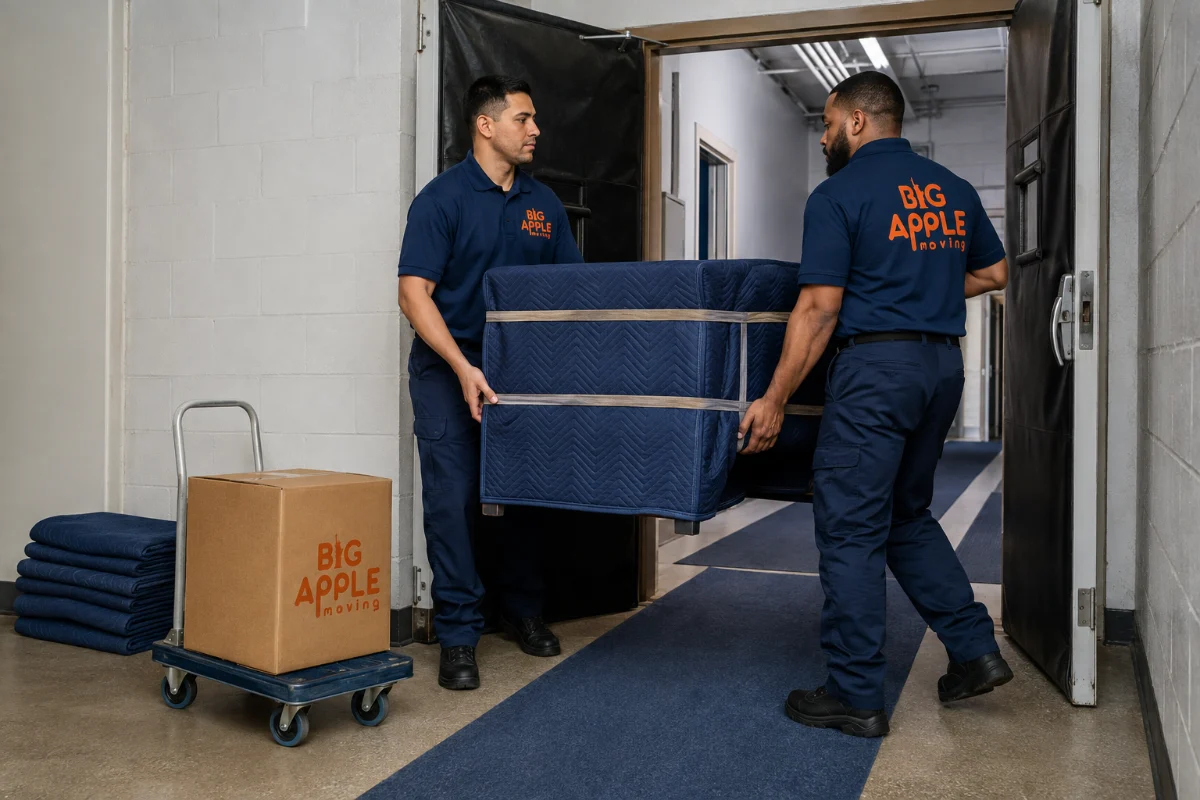
A rigid aquarium needs room to turn. Send photos and measurements of the tank, doorways, landings and stair turns before moving day. For a large or custom unit, the team plans the crew and equipment around its actual construction and route. Padding and wrapping protect the item during the agreed carry; the tank’s manufacturer instructions still govern how it is handled.
In an elevator building, confirm the cab and door dimensions, reservation window and building paperwork. A booked elevator is useful only if the tank fits through its opening and the approach. Include these details when arranging your residential move, and check the building’s certificate of insurance requirements. Big Apple Moving has served New York since 1979; explain the aquarium early so it can be planned as a specialty item.
Six Aquarium-Move Mistakes to Prevent
Leaving water in the tank
A short trip does not make a filled tank suitable for carrying. Drain it fully before the crew protects and moves it.
Leaving gravel or equipment inside
Remove substrate and decorations. Pack lids, lights and heaters separately; let equipment cool and follow its shutdown instructions before removal.
Drying or sterilizing the filter
The established media is part of the biological filter. Keep it wet and protected, and avoid untreated tap water or an unnecessary deep clean.
Putting livestock on the moving truck
BAM does not transport fish or other livestock. Keep their journey separate, with a responsible person managing the transport conditions.
Treating saved water as the whole solution
Reused water can help match conditions, but it does not replace healthy filter media. New water must be appropriately conditioned and matched to the system.
Introducing fish before the system is ready
Check equipment and water conditions first. If something is wrong, use the planned holding option and get aquarium advice instead of rushing acclimation.
Coordinate the Tank, the Fish and the Arrival
Before the crew arrives
Confirm the arrival window and have the draining and dismantling work planned. Prepare livestock close to the confirmed departure, leaving enough time to empty the tank. Avoid leaving packed fish in a parked car while furniture loads.
At the new address
Ask for the tank and stand to be accessible for early unloading, subject to the crew’s safe load plan. Clear their destination and have the aquarium supplies ready. Agree who will restart the system while the household move continues.
If the schedule slips
Have a suitable holding arrangement and an aquarium specialist’s contact ready. Container size, stocking, oxygen and temperature determine what the fish need; “one morning” is not a universal safe holding time.
For a long-distance move, arrange livestock care independently of the household delivery window. A specialist may be able to board fish or organize appropriate shipping once the destination is ready. Confirm the service in advance; do not assume the moving truck’s itinerary will suit the animals.
Moving a Fish Tank — Frequently Asked Questions
Yes. Big Apple Moving handles empty aquariums, stands and separately packed equipment as fragile specialty items. The tank must have no water, substrate or livestock inside. BAM does not transport live fish or other livestock; arrange that part yourself or with an aquarium specialist. Agree on the tank’s loading and arrival sequence before moving day.
Prepare a species-appropriate transport and acclimation plan with an aquatic retailer or specialist. Use suitable containers, control temperature, provide the required oxygen and keep the trip short. Protect the biological filter and check the destination water before introducing fish. No universal bagging time or fixed floating period guarantees a safe move.
No. Empty it completely, including gravel, sand and decorations, before the carry. Water adds roughly 8.34 pounds per US gallon, while movement can strain the aquarium and its seams. Even a short move across a room needs an empty tank and handling that follows its manufacturer’s instructions.
Use clean, food-safe containers with secure lids for any water you save, and keep them separate from chemicals. Keep established filter media wet in aquarium water and protect it from temperature extremes. Beneficial bacteria live mainly on media and other surfaces; saving water alone does not preserve the biological filter.
Freshwater weighs approximately 8.34 pounds per US gallon: about 83 pounds for 10 gallons, 250 for 30, 459 for 55 and 626 for 75. Those figures exclude the tank, stand, substrate and decorations. Actual water volume varies, and saltwater is heavier. Give the crew the empty aquarium’s dimensions and weight when available.
Arrange livestock transport separately from the household shipment. An aquarium specialist may offer boarding and suitable shipping, or help plan a dedicated journey. Confirm availability, destination readiness and a delay plan before booking. BAM can plan the empty tank’s move, but its truck schedule is not a livestock-care plan.
Yes. BAM has no fixed gallon limit for empty aquariums, including large and custom tanks. Send the dimensions, construction material, available empty weight and photos of the tank, stand and access route. The team reviews the condition, doorway and stair clearances, elevator access, equipment and crew needs before confirming the carry.
Make it an early arrival priority and agree on access and unloading with the crew. Place the tank on its suitable, level stand, restore the equipment and check water conditions before introducing fish. If the setup is delayed or unsuitable, use the holding arrangement agreed with your aquarium specialist rather than rushing fish into it.


